
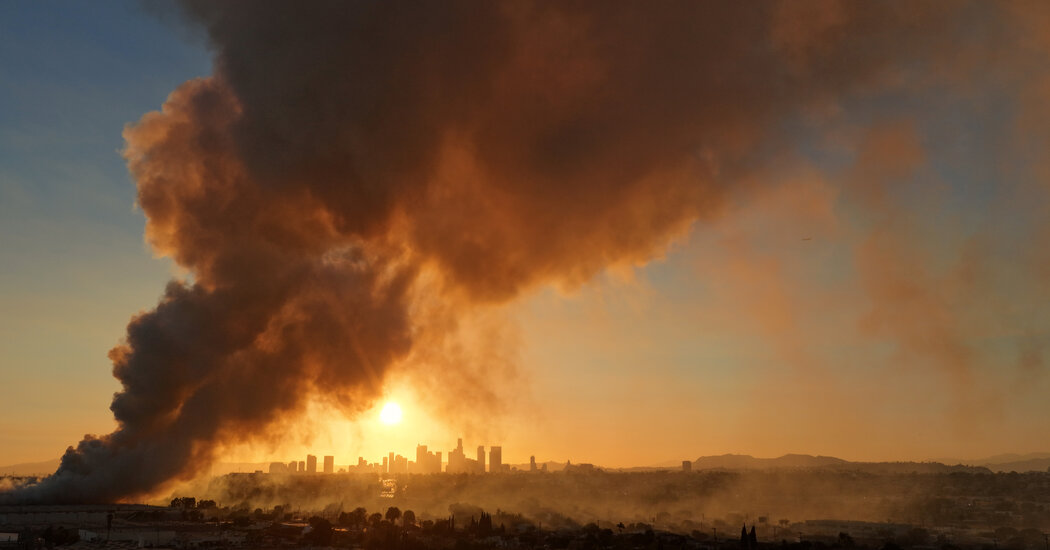
LOS ANGELES – Five days after a major fire erupted at a sprawling cold-storage facility in Boyle Heights, east of downtown Los Angeles, firefighters continue to battle persistent flare-ups. While the initial thick, black plume of smoke that blanketed the area has diminished into a diluted gray haze, the incident has had a profound and ongoing impact on the surrounding residential communities.
Residents in Boyle Heights and the adjacent working-class Latino community of East Los Angeles have reported significant health concerns and disruptions to daily life. Symptoms have included persistent breathing difficulties, headaches, and burning eyes, affecting individuals even within their homes. During the most intense periods of the blaze, visibility on local streets was severely reduced, with residents describing conditions where sightlines extended no further than a couple of car lengths.
Consuelo Granadas, an 80-year-old resident of Boyle Heights, articulated the severe conditions from outside her home on Monday afternoon. “It’s been incredibly difficult,” she stated, noting the pervasive smoke. “You can’t breathe inside the home. The smell is constant.”
Despite the challenging environment, Ms. Granadas has remained in her home, citing her unwillingness to abandon her cat and two dogs.
Just two blocks from the fire, in East Los Angeles, Mayra Grijalva, 60, prepared to step outside for a lunch break from her remote job, donning a white N-95 mask and sunglasses as a precaution. Even with taped door frames, the pungent smell of smoke had managed to infiltrate her residence, underscoring the pervasive nature of the air pollution.
Ms. Grijalva’s proactive measures were indicative of the community’s broader struggle. She was observed waiting at her gate for a county worker, who arrived with a clipboard to distribute vital resources. Upon being asked if she needed an air purifier, Ms. Grijalva confirmed, receiving a brown box and completing necessary paperwork. Across the street, other neighbors, also wearing masks, awaited their turn to receive assistance, highlighting the widespread demand for protective equipment and clean air solutions.
The financial strain on residents has been considerable. Ms. Grijalva reported spending over $600 for a hotel stay that accommodated her pets, an expense she indicated she could not afford to repeat. She also expressed discomfort with the idea of taking her pets to the public emergency shelters that had been established.
According to Captain Jacob Raabe, a spokesman for the Los Angeles Fire Department, firefighters have made significant headway in containing the blaze, which began on June 17. The fire’s spread into the thick, insulated exterior walls of the warehouse posed a particular challenge. Over the weekend, crews were able to strategically pry open these walls, allowing them to direct water onto critical areas that were previously inaccessible, a key turning point in the operation.
As of Monday, firefighting efforts remained intensive, with crews continuing the arduous process of removing sections of the warehouse walls and deploying water cannons and high-pressure hoses to extinguish deep-seated embers, Captain Raabe confirmed. The sheer scale and complexity of the cold-storage facility have necessitated a prolonged and methodical approach to firefighting.
Amidst the ongoing efforts, a palpable sense of frustration has emerged within the affected neighborhoods. Residents have questioned the permissibility of such a large-scale industrial facility operating in close proximity to densely populated residential areas, particularly given the potential for disasters of this magnitude.
The facility, which spans approximately 500,000 square feet, is operated by Lineage, a Michigan-based warehouse company. At the time of the fire, it was storing an estimated 42,500 tons of frozen food products.
Lineage acknowledged the severity of the situation in a public statement. “We know many people living near our facility in Boyle Heights are deeply distraught about the fire that began on June 17, and rightfully so,” the company stated, expressing empathy for the affected community.
In further statements on Monday, Lineage clarified that the building primarily stored perishable items such as meat, bread, and other foods, emphasizing that no hazardous materials were stored on site. The company also stated its active collaboration with the Los Angeles Fire Department, including assisting in the procurement of specialized firefighting equipment from out-of-town sources. Additionally, Lineage reported that it is providing direct aid to residents, distributing air purifiers, masks, and food supplies to those impacted by the smoke and disruptions.
Regarding the origin of the blaze, Lineage asserted that its operations and personnel were not responsible. The company indicated its belief that the fire initiated during testing being conducted by Altus Power, the owner of the rooftop solar array installed on the facility. Altus Power had not provided an immediate response to requests for comment regarding these claims as of Monday night.
The South Coast Air Quality Management District (SCAQMD) extended its advisory for poor air quality through midday Tuesday. While some localized improvements were noted in broader Los Angeles, the SCAQMD reported that “very unhealthy” air quality levels continued to be measured specifically in the Boyle Heights area, highlighting the concentrated impact on the immediate vicinity of the fire.
Professor Suzanne Paulson, who teaches in the department of atmospheric and oceanic sciences at the University of California, Los Angeles, offered insights into the potential health risks. She explained that smoke emanating from a fire, especially an industrial one, is likely to be more dangerous than typical urban air pollution. Industrial fires can generate particularly potent and complex mixtures of airborne particulate matter and gases.
Professor Paulson further noted that standard air quality indexes are primarily calibrated for “normal urban air pollution,” which primarily comprises vehicle emissions and other common industrial pollutants. This suggests that the current metrics might not fully capture the heightened toxicity of smoke from large-scale fires. “When we have smoke, it’s probably more toxic,” she concluded, underscoring the elevated health concerns for residents.
For some residents, the incident has highlighted broader systemic issues affecting working-class communities like Boyle Heights and East Los Angeles. There is a perception that these neighborhoods often bear the brunt of industrial development, with observers noting disparities such as more dilapidated sidewalks and less maintained public spaces compared to more affluent areas of the sprawling city.
These heavily Latino communities are characterized by a strong cultural identity, with both Mexican and American flags commonly displayed. Many families reside in multi-generational households, navigating the challenges of living in one of the country’s most expensive urban centers.
Adrian Rolon, a resident whose family lives adjacent to the burning warehouse, voiced a common sentiment of injustice. “It just seems unfair to build commercial buildings in residential areas where people are living where a crisis like this can happen,” he stated. Mr. Rolon expressed particular concern for his father, who has pre-existing health issues, noting that the smoke had become so unbearable that his brother relocated two hours away to stay with in-laws.
Mr. Rolon’s observations underscored the difficult choices confronting many residents: “A lot of people don’t have the resources to just up and leave,” he said. “So they stay and they close their windows and pray for the best.” This situation highlights the socio-economic vulnerabilities within these communities, where immediate relocation is often not a feasible option.
Georgia Gee contributed research.
Why This Matters
The ongoing cold-storage facility fire in Los Angeles highlights several critical issues with broad implications for urban planning, public health, and environmental justice. First, the incident underscores the significant public health risks associated with industrial fires, particularly when they occur in densely populated residential areas. The extended exposure to “very unhealthy” air quality, as identified by the South Coast Air Quality Management District, poses immediate and potential long-term respiratory and other health problems for thousands of residents. The comments from Professor Suzanne Paulson further emphasize that smoke from such fires can be more toxic than typical urban air pollution, and current air quality metrics may not fully capture the severity of the health threat.
Second, this event brings to the forefront longstanding concerns about environmental justice. The Boyle Heights and East Los Angeles neighborhoods are predominantly working-class Latino communities that have historically experienced a disproportionate burden of industrial development and associated pollution. Residents’ frustrations about a large industrial facility operating so close to homes reflect a pattern seen in many urban areas where lower-income communities and communities of color are often situated near industrial zones, leading to greater exposure to environmental hazards. This raises questions about zoning regulations, land-use planning, and the equitable distribution of environmental risks.
Third, the fire exposes vulnerabilities in emergency preparedness and response for marginalized communities. The struggle of residents like Mayra Grijalva to find affordable, pet-friendly temporary housing, and the observation that many cannot afford to “just up and leave,” reveal gaps in support systems for those most affected by disasters. While county workers and the operating company, Lineage, have provided some aid like air purifiers, the initial burden of expenses and the lack of accessible options disproportionately impact vulnerable populations.
Finally, the dispute over the fire’s origin between Lineage and Altus Power, the solar array owner, points to issues of corporate accountability and the complexities of multi-stakeholder responsibility in industrial incidents. Clear determination of fault is crucial for ensuring compensation for damages, implementing preventative measures, and reinforcing safety standards for industrial facilities, especially those incorporating newer technologies like rooftop solar panels. This incident serves as a stark reminder of the continuous need for rigorous oversight, transparent communication, and robust support mechanisms for communities living on the front lines of urban industrial activity.