
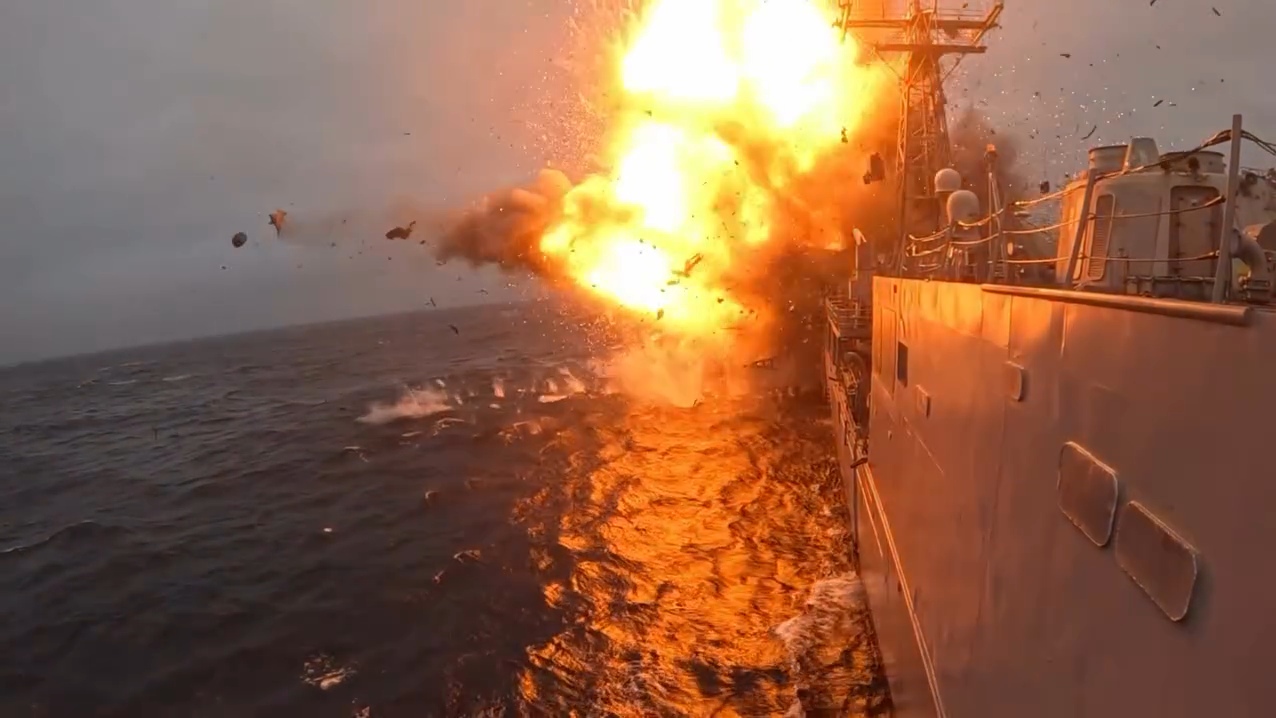
Exercise Atlantic Thunder 2026 Culminates in Sinking of Decommissioned U.S. Frigate off Scottish Coast
A major international naval exercise, Atlantic Thunder 2026, recently concluded with the intentional sinking of a decommissioned American frigate approximately 150 miles off the Western Isles of Scotland. The vessel went down in deep water as part of a live-fire training scenario, a process known as a Sinking Exercise (SINKEX), designed to test naval capabilities against a realistic target. QinetiQ, the company responsible for operating the range from which the exercise was controlled, has detailed its significant contribution to the complex operation.
QinetiQ operates the Ministry of Defence (MOD) Hebrides range under the Long-Term Partnering Agreement (LTPA), a strategic arrangement through which the company manages a substantial portion of the MOD’s vital test and evaluation infrastructure. During Atlantic Thunder 2026, QinetiQ personnel played a critical role in ensuring the safety and successful execution of the exercise. Stationed in the Range Control and Range Head buildings on South Uist, their teams were tasked with safeguarding a vast expanse of sea and airspace, meticulously managing potential hazards while live weapons were deployed into the designated target area.
Will Blamey, Chief Executive of QinetiQ UK Defence, underscored the demanding nature of the event: “Atlantic Thunder is a complex exercise, delivered in partnership with the US Sixth Fleet and Royal Navy to ensure they are warfighting ready. Our experts coordinate a range of activity to ensure the exercise is successful for our partners, from managing the safety of a vast area of sea and air space, to planning and overseeing the realistic live-fire scenarios.” This statement highlights the intricate coordination required to facilitate such a large-scale, multi-national military drill, emphasizing both the logistical and strategic importance of QinetiQ’s involvement.
Beyond range management and safety oversight, QinetiQ also contributed its advanced hardware to enhance the realism of the exercise. The company deployed its Banshee Whirlwind uncrewed aerial targets, operated by the Combined Aerial Targets Service (CATS). These sophisticated drones conducted multiple sorties over the exercise area, simulating realistic aerial threats for the participating naval forces. The targets’ movements and behavior were meticulously tracked by an RAF P-8 Poseidon maritime patrol aircraft, further integrating diverse platforms and capabilities into the training environment and providing valuable data on detection and engagement.
The MOD Hebrides range, situated across South Uist and its surrounding islands, stands as a unique and indispensable asset within the United Kingdom’s defense infrastructure. It is the only location in the UK capable of accommodating an exercise of this magnitude and complexity, particularly one involving live-fire against a large, decommissioned vessel. This unique capability explains the practical rationale behind towing an American hull across the Atlantic Ocean specifically for its eventual sinking off the coast of Scotland, rather than disposing of it closer to its home waters. The range’s expansive and relatively unpopulated sea and airspace offer unparalleled opportunities for testing advanced weapon systems and training naval forces in realistic combat scenarios, making it a critical hub for international defense cooperation and readiness.
Why This Matters
The successful conclusion of Exercise Atlantic Thunder 2026 and the SINKEX of a U.S. frigate hold significant implications for international defense, technological development, and strategic readiness. Firstly, such exercises are paramount for maintaining the combat effectiveness and interoperability of allied naval forces. The participation of the U.S. Sixth Fleet and the Royal Navy underscores the enduring partnership between the United States and the United Kingdom, vital for collective security within NATO and beyond. Realistic live-fire scenarios, including the targeting of an actual ship, provide invaluable training that cannot be replicated through simulations alone, ensuring that crews are ‘warfighting ready’ for contemporary and future maritime challenges.
Secondly, Atlantic Thunder serves as a critical testbed for advanced weapon systems, sensors, and tactics. The sinking of a decommissioned vessel allows navies to evaluate the destructive power and accuracy of their anti-ship missiles, torpedoes, and other ordnance in a controlled yet realistic environment. This feedback is essential for the continuous development and refinement of naval technology, driving innovation and ensuring that military hardware meets the demands of modern warfare. The integration of uncrewed aerial targets, like QinetiQ’s Banshee Whirlwind, further enhances this aspect by providing dynamic, simulated adversary threats for systems like the RAF P-8 Poseidon to detect and track, advancing multi-domain operational capabilities.
Thirdly, the exercise carries significant geopolitical weight. In an era of evolving global security landscapes and increased competition in maritime domains, demonstrating the ability to project power and conduct complex naval operations sends a clear message of deterrence to potential adversaries. The capability to conduct SINKEX events showcases a nation’s commitment to maintaining a robust and modern navy, capable of defending national interests and contributing to international stability. The unique capabilities of the MOD Hebrides range, enabling the UK to host such a high-profile exercise, also reinforces the United Kingdom’s role as a key player in global defense and a valuable ally.
Finally, the involvement of companies like QinetiQ highlights the symbiotic relationship between private industry and national defense. QinetiQ’s expertise in operating critical defense infrastructure, managing complex ranges, and providing advanced target systems is indispensable for modern military training and evaluation. This not only supports national security but also underpins a specialized defense industry, fostering high-tech jobs and contributing to the economy. The success of Atlantic Thunder 2026 thus demonstrates not just naval power, but also the sophisticated logistical, technological, and collaborative framework that underpins contemporary defense readiness.