
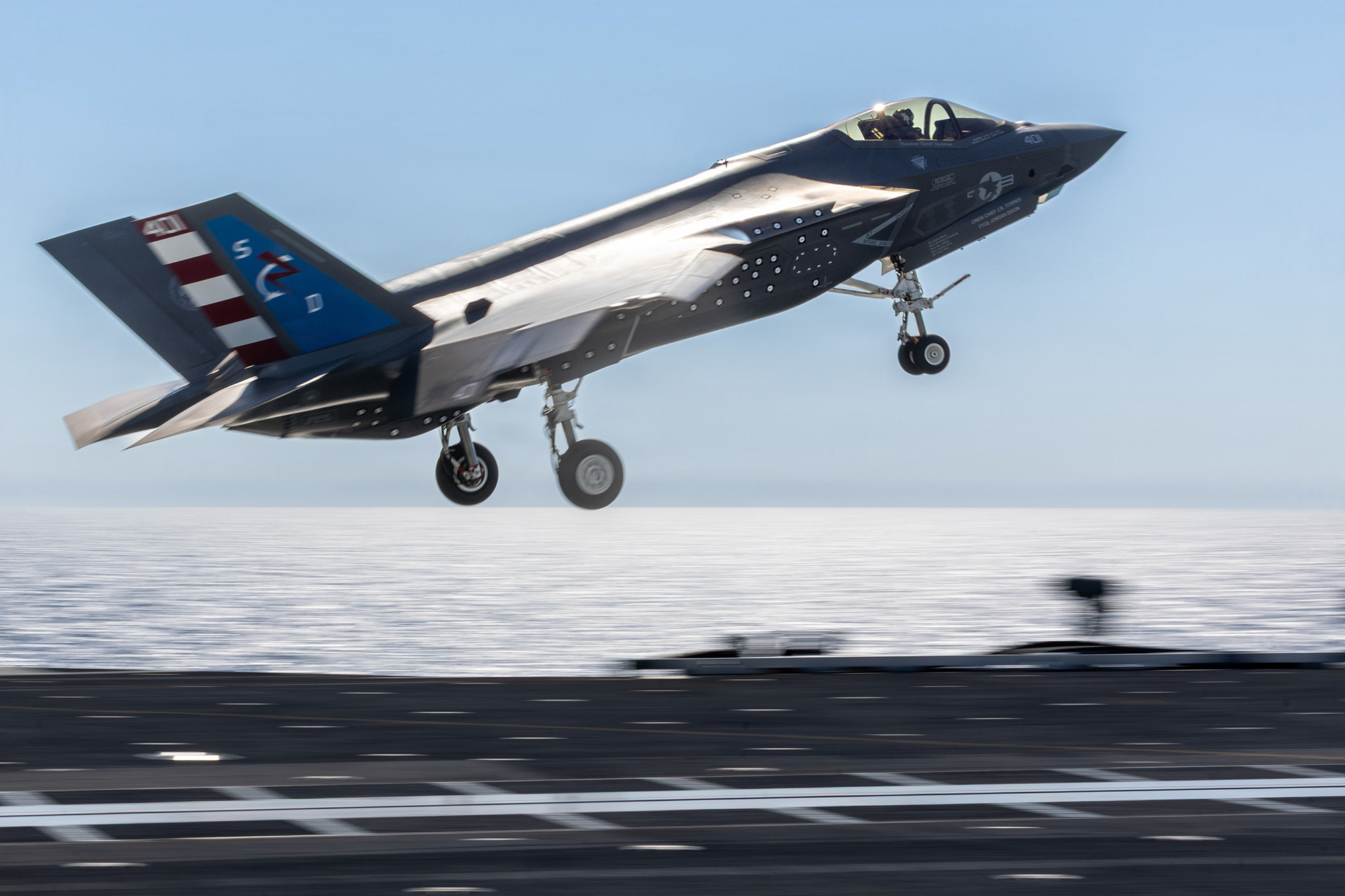
F-35C Achieves First Arrested Landing Aboard Future USS John F. Kennedy, Advancing Carrier Compatibility Trials
A U.S. Navy F-35C Lightning II stealth fighter successfully completed its first arrested landing aboard the future USS John F. Kennedy (CVN 79), a Gerald R. Ford-class aircraft carrier, on October 13 in the Atlantic Ocean. This significant milestone was part of ongoing aircraft compatibility testing for the Navy’s newest class of supercarriers.
The landing took place aboard the Pre-Commissioning Unit (PCU) John F. Kennedy, the second vessel in the Gerald R. Ford class. A PCU designation indicates that the ship is built and launched but not yet formally commissioned into active service, a phase during which it undergoes extensive trials ahead of its anticipated delivery to the U.S. Navy.
Personnel and aircraft from Air Test and Evaluation Squadron (VX) 23, known as the “Salty Dogs,” have been conducting flight operations from the carrier’s deck during these trials. Following the initial arrested landing, an F-35C was observed performing touch-and-go operations on October 14. A “touch-and-go” involves an aircraft landing on the flight deck, rolling for a short distance, and then taking off again without coming to a complete stop, serving as a valuable exercise for pilots and deck crews in high-tempo operations.
The current phase of operations, termed Aircraft Compatibility Testing (ACT), is designed to rigorously assess whether the carrier’s integrated launch and recovery equipment can safely and reliably support all aircraft types expected to operate from its flight deck during its extensive service life. For the F-35C, a crucial aspect of this testing involves its interaction with two hallmark innovations of the Ford class: the Electromagnetic Aircraft Launch System (EMALS) and the Advanced Arresting Gear (AAG).
EMALS represents a significant technological leap from the steam catapults traditionally used on preceding Nimitz-class carriers. This electrically driven system uses linear induction motors to accelerate aircraft from the flight deck. It offers several advantages, including a smoother launch for aircraft, more precise control over launch energy, and the capability to launch a wider range of aircraft—from lighter drones to heavier fighter jets—with potentially less stress on their airframes. Conversely, AAG manages the recovery phase, absorbing the kinetic energy of an incoming aircraft when its tailhook engages one of the arresting wires stretched across the deck. Unlike older hydraulic systems, AAG employs a water-turbine-based energy absorption system, providing greater flexibility and gentler deceleration for the aircraft, which can reduce wear and tear on both the aircraft and the ship’s systems.
The F-35C is the U.S. Navy’s carrier variant of the Lockheed Martin Joint Strike Fighter. Specifically engineered for conventional aircraft carrier operations, it features larger wing surfaces for improved low-speed handling and increased fuel capacity, strengthened landing gear to withstand the impact of carrier landings, and a robust tailhook assembly essential for arrested recoveries. Its design allows it to operate from carriers equipped with both catapult launch and arresting gear systems, making it a cornerstone of future naval aviation capabilities due to its stealth, sensor fusion, and multirole combat abilities.
The successful test on October 13 was not an isolated event but part of a comprehensive series of trials. The U.S. Navy emphasized that these tests are a critical evaluation of the operational capabilities of the ship’s aircraft launch and recovery equipment, ensuring seamless integration with the diverse fleet of Navy aircraft.
The USS John F. Kennedy is the second Gerald R. Ford-class carrier, following the lead ship, USS Gerald R. Ford (CVN 78), which was commissioned in 2017. The Ford class introduces a revolutionary redesign of carrier aviation systems compared to the Nimitz class, which has formed the backbone of the U.S. Navy’s carrier fleet for decades. Key advancements include the aforementioned EMALS and AAG, a reconfigured flight deck layout designed for increased sortie generation rates (the rate at which aircraft can be launched and recovered), and a substantially increased electrical generating capacity to power future technologies and systems. These innovations aim to enhance combat effectiveness, improve operational efficiency, and potentially reduce crew workload over the carrier’s projected 50-year lifespan.
At full load, the carrier displaces approximately 100,000 tonnes and is powered by two A1B nuclear reactors, providing virtually unlimited range and endurance, allowing for sustained operations globally without frequent refueling. Its expansive flight deck spans over 330 meters in length, capable of accommodating a large and varied embarked air wing. This air wing is projected to include advanced aircraft such as F/A-18E/F Super Hornets, EA-18G Growler electronic warfare aircraft, E-2D Advanced Hawkeye airborne early warning aircraft, a variety of utility and anti-submarine warfare helicopters, and the cutting-edge F-35C Lightning II stealth fighters.
Notably, the USS John F. Kennedy incorporates several design refinements distinguishing it from the lead ship. A significant change is its radar suite; from CVN 79 onwards, the class utilizes the AN/SPY-6(V)3 Enterprise Air Surveillance Radar (EASR) in conjunction with the AN/SPQ-9B surface search radar, moving away from the dual-band radar arrangement installed on USS Gerald R. Ford. These upgrades reflect continuous improvements based on lessons learned and technological advancements implemented during the construction process.
The ship remains in its pre-commissioning phase, with its formal delivery to the U.S. Navy anticipated in 2027. These latest aviation trials are a vital component of the extensive test and evaluation program required before the carrier can enter operational service and begin the process of fully integrating its embarked air wing. The successful arrested landing of an F-35C on October 13 represents a significant step forward in preparing the USS John F. Kennedy for its pivotal role in national defense.
Why This Matters
The successful arrested landing of an F-35C Lightning II aboard the future USS John F. Kennedy marks a critical juncture for U.S. naval power and global security for several key reasons:
- Validation of Next-Generation Carrier Technology:This event is a crucial validation of the Gerald R. Ford-class aircraft carrier’s advanced systems, specifically the Electromagnetic Aircraft Launch System (EMALS) and Advanced Arresting Gear (AAG). These technologies, which represent a significant departure from previous systems and have faced developmental hurdles on the lead ship, USS Gerald R. Ford, are fundamental to the operational concept of the new class. Their successful performance on CVN 79 demonstrates increasing maturity and reliability, proving the U.S. Navy’s long-term vision for its carrier fleet.
- Integration of Fifth-Generation Airpower:The F-35C is the cornerstone of the U.S. Navy’s future carrier air wing, providing stealth, advanced sensor fusion, and multirole capabilities critical for modern naval warfare. Its seamless integration with the Ford-class carriers is essential for the Navy to maintain its technological advantage and deliver cutting-edge airpower from the sea. This test ensures that the most advanced naval fighter can operate effectively and safely from the most advanced aircraft carrier.
- Enhancing Military Readiness and Power Projection:Aircraft carriers are the central pillar of U.S. power projection globally, serving as sovereign airfields capable of deploying anywhere in the world. The successful progression of USS John F. Kennedy’s testing means the U.S. Navy is closer to adding another fully capable, state-of-the-art supercarrier to its fleet. Each operational carrier strike group significantly enhances the Navy’s ability to respond to crises, deter aggression, and protect international interests across vital maritime regions.
- Long-Term Strategic Investment:The Ford-class carriers represent a multi-decade, multi-billion dollar investment in national defense. Each ship is designed for a 50-year service life. Validating its core systems and its ability to operate current and future advanced aircraft ensures the longevity and effectiveness of this strategic asset, securing U.S. naval dominance well into the latter half of the 21st century and safeguarding national interests for generations.
- Maintaining Technological Superiority:In an era of evolving geopolitical challenges and near-peer competition, maintaining a technological edge is paramount. The Ford-class carriers, with their enhanced sortie rates, increased power generation for future systems, and ability to operate advanced aircraft like the F-35C, are designed to deliver superior combat capability. This milestone reinforces the U.S. commitment to investing in and deploying the most advanced military platforms globally, signaling its resolve to competitors and allies alike.
- Economic and Industrial Impact:The construction and testing of these mega-carriers, along with their associated aircraft, support a vast defense industrial base, providing skilled jobs and driving technological innovation across numerous sectors in the United States, thereby contributing significantly to the national economy.