
U.S. Economic Growth Slows Amid Geopolitical Tensions and Inflationary Pressures, AI Investment Provides Underlying Strength
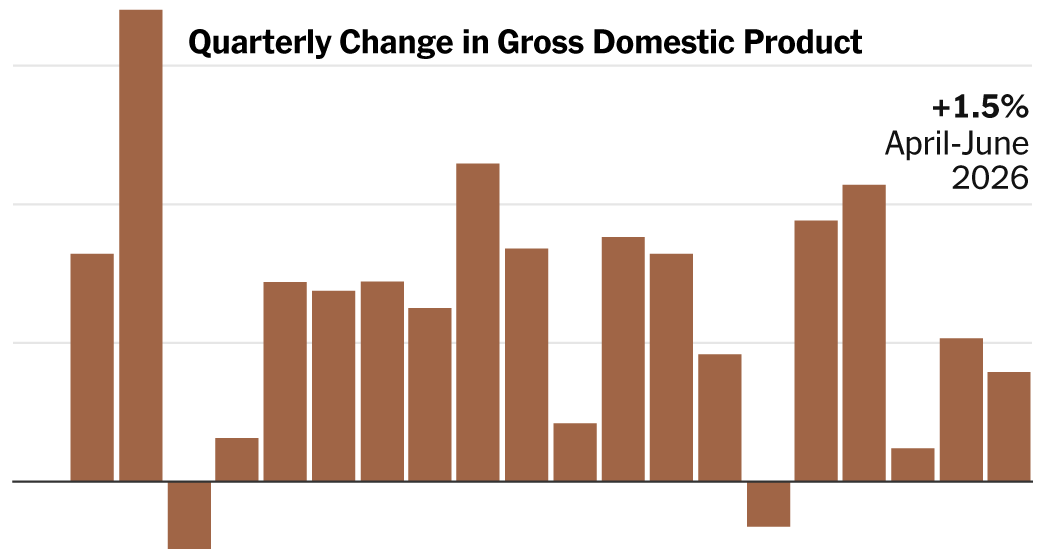
The American economy registered a slower pace of expansion in the second quarter of the year, with its Gross Domestic Product (GDP) growing at an annual rate of 1.5 percent. This deceleration comes as global geopolitical events, particularly the ongoing conflict with Iran, continue to disrupt commodity prices, supply chains, and energy markets worldwide.
While global oil prices have retreated from their peaks observed in the spring, the residual impact of earlier surges is still being felt across the economy. Households and businesses continue to contend with elevated prices for gasoline and a range of other petroleum-based products. Given that GDP figures are adjusted for inflation, these persistent higher costs have effectively dampened the reported growth rate, masking some underlying economic activity.
The 1.5 percent growth rate for the second quarter represents a decline from the 2.1 percent annual rate recorded in the first quarter of the year. Despite the headline slowdown, closer examination of the data reveals areas of relative strength within the economy. Consumer spending and business investment, particularly in sectors related to the burgeoning artificial intelligence (AI) industry, have demonstrated resilience. An underlying “core” measure of growth, which aggregates consumer spending and gross private investment, notably increased by 3.9 percent in the second quarter, a significant acceleration from the 1.7 percent recorded in the first quarter.
Eric Wallerstein, a former advisor at the Federal Reserve and currently the chief macro strategist at Clocktower Group, an asset management and advisory firm, commented on this mixed picture. “Underlying growth was strong,” Wallerstein stated. However, he also cautioned, “real incomes and spending have been trending lower,” highlighting the challenge that inflation poses to consumers’ purchasing power.
This GDP figure for the second quarter is the initial estimate provided by the U.S. Bureau of Economic Analysis. It is important to note that these preliminary estimates are subject to revisions, which can be substantial, particularly during periods marked by price volatility. These revisions are conducted by civil servants within the agency as more complete data becomes available.
Further analysis of economic indicators by financial researcher Viresh Kanabar indicates a positive trend in business orders and expenditures. Retail sales have also maintained robust performance over several months. However, Mr. Kanabar’s data also illustrates a stark contrast: when adjusted for inflation, consumer purchases are growing at a much softer pace. He points out that “real” inflation-adjusted income has experienced an overall decline over the past six months, a rate not witnessed since the peak of the inflation surge in 2022.
In its simplest terms, GDP serves as an account of the exchange of goods and services within an economy. GDP growth is a dynamic interplay of four primary factors: business investment, government expenditures, net exports, and household consumption. Household consumption typically constitutes approximately 70 percent of the U.S. economy. While consumer spending and business investment demonstrated strength in the second quarter, a pullback in net government spending and an increase in imports acted as drag factors, limiting overall economic momentum.
Dan Alpert, a senior fellow in macroeconomics at Cornell Law and managing partner at Westwood Capital, a financial firm, characterized the current economic climate as a “chug-along economy until further notice,” suggesting a period of steady but unremarkable growth.
Adding to the economic landscape, the Trump administration had previously imposed tariffs ranging from 10 to 12 percent on imports from over 80 countries. These global tariffs faced criticism from economists, and many were subsequently overturned by courts. While economists generally do not anticipate the remaining tariffs to trigger a recession, many believe they contribute to slower growth and higher prices for consumers. One estimate by Yale researchers suggested that these import duties were costing the average American family around $1,100 annually.
Business leaders largely express confidence that the Iran conflict will remain contained, with limited widespread harm to broader commercial activity. Nevertheless, the Strait of Hormuz, a critical maritime chokepoint for global oil shipments, remains partially under Iran’s control and is not yet considered a consistently reliable passage for international shippers. Market analysts have issued warnings that international oil inventories are depleting rapidly, raising the specter of widespread energy shortages recurring in the near future.
A mitigating factor in the face of energy price volatility has been the decreased “energy intensity” of both the domestic and global economies. The amount of energy required to generate a dollar of economic growth has fallen significantly, by about a third in the United States and Europe since 2000, and by approximately 40 percent in China. Despite this efficiency gain, persistently low crude inventories could still trigger a new inflationary surge in oil prices, potentially halting economic growth.
There is already some evidence indicating that the recent jump in energy prices has started to permeate other sectors of the economy. Grocery prices are projected to rise, and airfares, which have already seen substantial increases, are not expected to decline in the short term.
In monetary policy news, the Federal Reserve opted to hold interest rates steady at its most recent meeting. However, three of the twelve members on the Fed’s policymaking committee dissented, voting in favor of raising rates. This signals mounting pressure within the central bank to address inflation. Kevin M. Warsh, the new chairman of the Fed, has publicly committed to reining in inflation. Yet, like his predecessors, he faces the delicate balancing act of tightening monetary policy without unduly harming economic growth and the labor market.
The labor market has shown signs of stabilization this year when compared to the volatility experienced in 2025. The pace of payroll growth over the past three months, though uneven, has averaged 111,000 jobs per month. Some observers of the Fed suggest that this stabilization provides Chairman Warsh and other Fed leaders with greater flexibility to consider interest rate hikes without significantly jeopardizing employment figures.
In financial markets, yields on long-term bonds have recently climbed, reflecting investor concerns that sustained elevated inflation will erode the future value of certain assets. While investors have expressed apprehension about a potential “AI bubble,” stock indexes have largely performed well this year, and corporate earnings have continued to surpass expectations.
According to data compiled by FactSet, the S&P 500’s net profit margins are on track to reach 16 percent in the latest quarter, marking the highest level since FactSet began tracking this metric in 2009. Economists are now grappling with a mix of wonder and anxiety regarding the potential degree to which the AI boom and overall GDP growth could become interconnected.
A pivotal question remains concerning the future returns on the massive investments being channeled into AI. Large corporations are leveraging both debt and billions of dollars in cash flow to fulfill their investment commitments in this sector. AI systems demand extensive, energy-intensive physical infrastructure, including specialized chips, vast networks of cables, and sophisticated cooling systems. The expansion of these underlying physical systems is a central driver of the immense investment boom currently underway among businesses developing AI technologies. Goldman Sachs estimates that capital expenditures on artificial intelligence could reach $765 billion by the end of the year.
Interestingly, some statistical peculiarities mean that this significant AI build-out, which heavily relies on imported foreign components rather than domestically produced parts, is paradoxically tempering measures of domestic growth. Jake Oubina, a managing director and deputy head of economic research at Piper Sandler, an investment firm, explained, “From a G.D.P. math standpoint, a lot of the A.I.-related capital expenditure, which adds substantially to G.D.P., gets offset by the fact that we import most of what goes into the data centers.”
Looking ahead, federal tax refunds that provided a boost to household finances in the spring are now largely depleted. With household savings buffers considerably lower than in the recent past, Eric Wallerstein of the Clocktower Group anticipates a weakening in consumer spending. “Consumption will be much weaker through the rest of the year,” he argued. Despite the current mixed signals, Wallerstein underscored the transformative power of AI, stating, “Yes, the A.I. boom is not 100 percent of G.D.P., but it is an A.I.-driven economy.”
Why This Matters
The current state of the U.S. economy, characterized by slowing overall growth juxtaposed with underlying strengths and significant inflationary pressures, holds profound implications for individuals, businesses, and global stability. For the average person, the continued impact of inflation on everyday goods, from gasoline and groceries to airfares, means a shrinking purchasing power and increased cost of living. Depleted savings buffers and exhausted tax refunds suggest that many households may face tighter financial constraints in the coming months, potentially leading to a pullback in discretionary spending and an increased reliance on credit.
For businesses, particularly small and medium-sized enterprises, the dual challenge of higher operational costs due to inflation and a potential slowdown in consumer demand creates a complex operating environment. Investment decisions, especially outside the booming AI sector, may become more cautious. Conversely, the massive capital expenditures in artificial intelligence signal a transformative shift in industrial priorities, promising future efficiencies and new markets but also raising questions about job displacement and the equitable distribution of economic benefits.
Policymakers at the Federal Reserve face a difficult balancing act. The pressure to curb inflation, as evidenced by dissenting votes for rate hikes, conflicts with the risk of stifling economic growth and potentially harming the labor market. Their decisions on interest rates will directly influence borrowing costs for everything from mortgages to business loans, impacting investment and consumption. Government fiscal policy, including trade tariffs and spending priorities, also plays a crucial role in shaping the economic landscape.
Globally, the U.S. economy’s performance reverberates far beyond its borders. A slowdown in American demand can impact international trade partners, while its energy security concerns, particularly regarding the Strait of Hormuz, have direct implications for global oil prices and supply chain stability. The U.S. response to geopolitical conflicts and its economic resilience in the face of inflation are closely watched indicators for international markets and central banks worldwide.
Ultimately, this period represents a crucial juncture. The interplay of geopolitical instability, persistent inflation, technological transformation driven by AI, and evolving monetary policy will determine the trajectory of economic growth, the stability of financial markets, and the everyday well-being of millions of people in the United States and across the globe. Understanding these dynamics is essential for navigating the complex economic landscape ahead.