
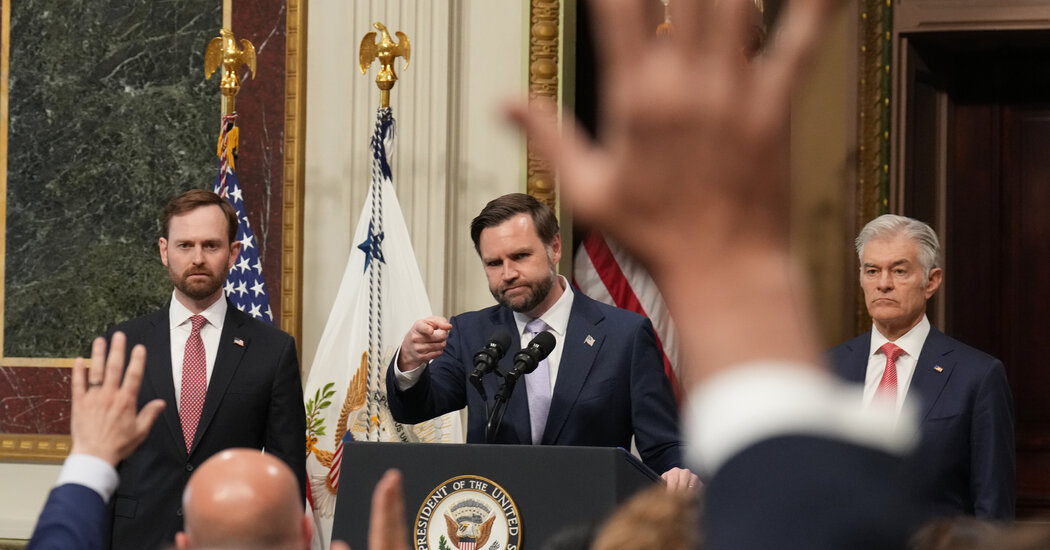
Washington D.C. – The Trump administration announced on Wednesday its intent to withhold $1.3 billion in federal Medicaid payments from the state of California, citing the state’s alleged failure to adequately combat fraud within the expansive public health insurance program. Vice President JD Vance delivered the announcement during a White House news conference, emphasizing the administration’s intensified focus on program integrity and fraud prevention across federal health initiatives.
“The state of California has not taken fraud very seriously,” Mr. Vance stated, providing the administration’s rationale for the significant financial action. This move targets federal contributions to Medi-Cal, California’s Medicaid program, which serves over 15 million low-income residents, children, and individuals with disabilities. The withholding represents a substantial portion of federal funds typically allocated to support the program’s operations and services, which are vital for the program’s solvency and service delivery.
Beyond the direct action against California, Vice President Vance also announced a nationwide audit of state-level watchdog agencies known as Medicaid Fraud Control Units (MFCUs). These units are statutorily mandated by the federal government to investigate and prosecute Medicaid provider fraud and instances of patient abuse or neglect in healthcare facilities. Letters were dispatched to these offices on Wednesday, requesting them to demonstrate their effectiveness and assertiveness in combating Medicaid fraud. Mr. Vance cautioned that these units, too, could face reductions in federal funding if their efforts are deemed insufficient or if they fail to meet federal performance benchmarks.
This series of announcements underscores the administration’s escalating emphasis on identifying and rectifying misuse of public funds in federal health insurance programs. In March, President Trump formally established a task force specifically dedicated to cracking down on such irregularities, appointing Vice President Vance to lead the interagency group. The task force’s mandate is to enhance oversight, improve data analytics, and coordinate enforcement actions to protect taxpayer dollars and ensure the integrity of critical health and welfare programs across the nation.
The administration’s recent actions in this domain have predominantly focused on states governed by Democratic leadership. In February, a similar financial penalty was imposed on Minnesota, with the administration halting $259 million in federal payments following a significant welfare scandal within that state. The Minnesota government has since legally challenged that decision in court, setting a precedent for potential legal battles over such federal withholdings and disputes over state compliance with federal regulations.
Dr. Mehmet Oz, Administrator of the Centers for Medicare and Medicaid Services (CMS) and a prominent member of the anti-fraud task force, has frequently highlighted California’s hospice industry as a particularly problematic area ripe for fraud. During a recent event hosted by the Paragon Institute, a conservative health policy think tank, Dr. Oz pointed to an unusual concentration of providers. “There is something clearly wrong,” Dr. Oz remarked, noting that an estimated one-third of all hospice providers in the state were located within Los Angeles, a demographic anomaly that raises significant red flags regarding potential fraudulent activity.
Hospice care, designed for individuals with terminal illnesses, is particularly vulnerable to fraud due to its reliance on certifications of terminal illness and the potential for abuse related to billing for services not rendered, for unnecessary services, or for patients who do not meet strict eligibility criteria. Concerns often include providers billing for unprovided services, enrolling ineligible beneficiaries who are not terminally ill, or engaging in kickback schemes for patient referrals. The high concentration in Los Angeles has fueled suspicions of organized fraud rings exploiting the system.
In a related development on Wednesday, Medicare announced the implementation of a six-month moratorium on approving new hospice providers. This temporary halt is intended to allow the agency critical time to investigate existing providers, identify potential cases of fraud and abuse, and implement stricter oversight mechanisms before new entities can enter the market. The moratorium reflects a broader strategy to proactively address vulnerabilities in certain healthcare sectors identified as high-risk for fraudulent schemes, particularly those with rapid growth or unusual provider distributions.
While the Trump administration asserts these measures are essential to protect taxpayer funds and maintain the integrity of vital social programs, the state of California is expected to vigorously contest the federal decision. Such disputes typically involve complex legal arguments regarding federal authority, state compliance with federal mandates, and the interpretation of program regulations and performance metrics. Governor Gavin Newsom’s office has not yet issued a formal statement regarding the specific withholding, but historical patterns suggest a robust defense of California’s Medicaid oversight practices and a potential legal challenge similar to Minnesota’s, aimed at restoring the federal funding.
Why This Matters
The Trump administration’s decision to withhold $1.3 billion in federal Medicaid funding from California, alongside a nationwide audit of state fraud control units and a moratorium on new hospice providers, carries significant implications for healthcare policy, federal-state relations, and the millions of Americans who rely on public health insurance programs. These actions highlight a growing tension between federal efforts to ensure program integrity and the states’ responsibilities in managing these vital services.
For California, the immediate impact of losing $1.3 billion could be substantial. Medi-Cal, the state’s Medicaid program, is a critical safety net, providing healthcare access to a quarter of its population. A reduction in federal contributions could strain the state’s budget, potentially forcing California to either increase its own spending to cover the shortfall, reduce services, or delay payments to providers. Any of these scenarios could directly affect the quality and accessibility of care for vulnerable populations, including low-income families, seniors, and individuals with disabilities who depend on Medi-Cal for their healthcare needs.
On a broader scale, the nationwide audit of Medicaid Fraud Control Units (MFCUs) signals a more aggressive federal stance on oversight. This could lead to increased scrutiny and potential funding cuts for other states, regardless of their political alignment, if their fraud detection and prosecution efforts are deemed inadequate by federal standards. While the stated goal is to combat fraud and protect taxpayer dollars, such interventions can be perceived by states as overreach into their sovereign management of federal-state partnership programs. This dynamic often fuels legal challenges, as seen with Minnesota’s opposition to a similar federal withholding, potentially creating a complex legal landscape for federal health programs.
The specific focus on the hospice industry, culminating in a Medicare moratorium, underscores vulnerabilities within certain healthcare sectors. While necessary to root out fraudulent practices that siphon taxpayer money and compromise patient care, such moratoria can also have unintended consequences. They may potentially delay access to legitimate and vital end-of-life care services for new patients in affected areas, particularly if the moratorium is broad and not narrowly targeted. Balancing the imperative to prevent fraud with the need to ensure timely access to appropriate medical care remains a persistent challenge for healthcare regulators and policymakers.
Ultimately, these actions represent a significant shift in the federal government’s approach to Medicaid administration, signaling a move towards more stringent federal oversight and enforcement. They raise fundamental questions about the balance of power between federal and state authorities in jointly funded programs, the effectiveness of current fraud prevention mechanisms, and the potential impact on millions of beneficiaries caught in the crossfire of these policy disputes. The unfolding situation will likely influence future healthcare funding debates and the ongoing evolution of federal-state partnerships in delivering essential social services across the United States.