
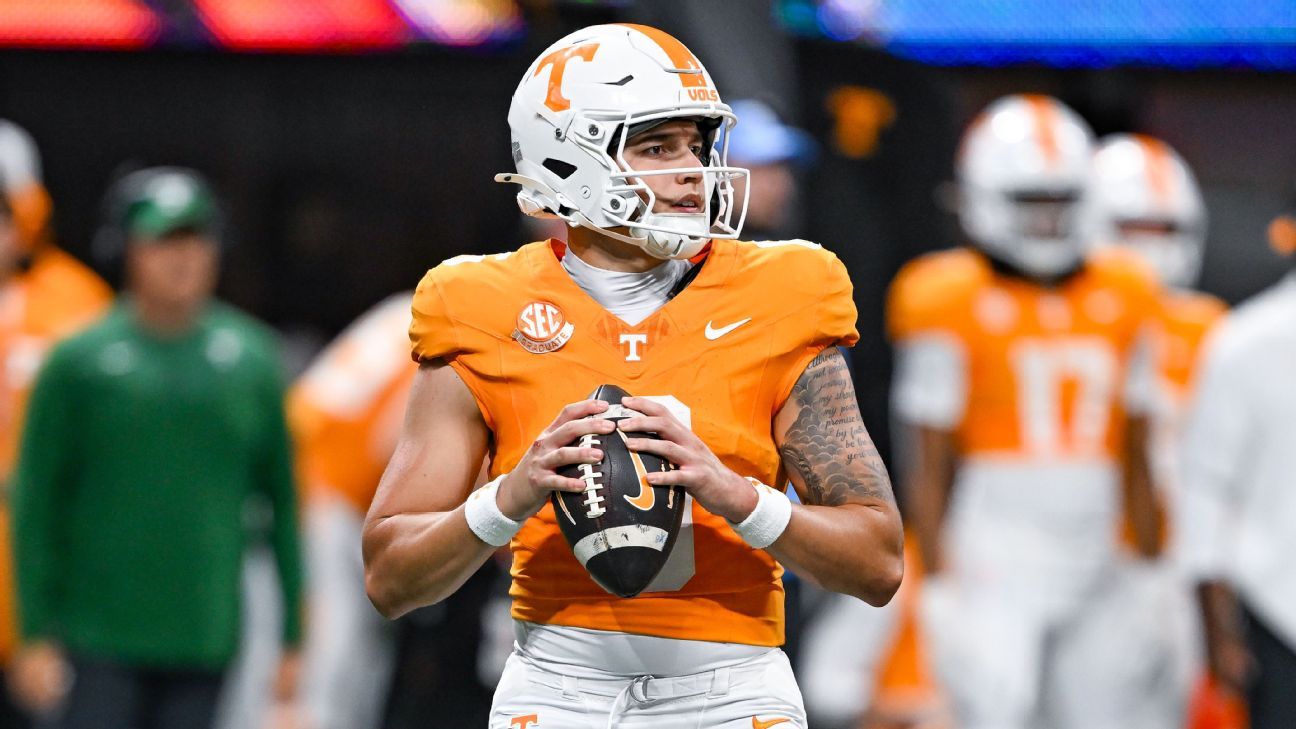
A state magistrate in Tennessee on Friday rejected Tennessee quarterback Joey Aguilar’s plea for a preliminary injunction to participate with the Volunteers this season, thereby effectively concluding his collegiate athletic tenure.
Aguilar’s legal representatives had contended that his two years competing at a junior college institution ought not to be factored into his four-year eligibility window in Division I.
Before enrolling with the Volunteers the previous year, the 24-year-old Aguilar had competed for two seasons at Diablo Valley Community College in California, followed by an additional two seasons at Appalachian State.
The Volunteers suffered a significant setback with Chancery Christopher D. Heagerty’s verdict, delivered on Friday in Knoxville, Tennessee’s Knox County Chancery Court, as the team currently lacks an obvious successor for Aguilar in the impending season.
Judicial documents filed by Aguilar’s legal representatives suggested he was poised to generate approximately $2 million through his involvement with the Volunteers during the current season.
Whether Aguilar’s legal team would appeal the decision was not instantly apparent. Nonetheless, he is slated to take part in the NFL scouting combine next week.
In his prior judgment on Feb. 4, Heagerty had issued Aguilar a temporary 15-day protective order, remarking that the quarterback had “shown a strong probability of prevailing based on the factual merits of his assertion.”
This outcome represents a notable triumph for the NCAA, an organization that has contended with multiple legal disputes regarding its qualification regulations. Separately, a Mississippi magistrate determined last week that Ole Miss quarterback Trinidad Chambliss fulfilled the prerequisites for a medical redshirt for a sixth season and is qualified to compete for the Rebels this season.
“The NCAA is grateful for the magistrate’s ruling today, which underscores the judiciary’s regard for qualification standards and safeguarding entry to the university experience for present and prospective student-athletes,” the NCAA declared in an official release. “We will persist in safeguarding the NCAA’s qualification rules from efforts to bypass fundamental guidelines and obstruct equitable rivalry for all student-athletes. The NCAA is implementing modifications to furnish greater advantages to student-athletes and will continue to collaborate with legislative bodies to ensure constancy for all college athletes.”
During the previous week’s proceedings, Taylor Askew, legal counsel for the NCAA, an alumnus of UT’s Winston College of Law and a Knoxville native, contended that Aguilar’s tenure had run its course.
“My affection for Tennessee football is profound,” Askew passionately stated. “I hail from Knoxville; I was raised observing its games. My children follow his performances in every match. But eventually, when legal authorities review such documentation, and here in Tennessee, it becomes imperative to declare: ‘Tennessee is better than this. We’re superior to this. We don’t have to resort to legal action to reclaim our player. We don’t have to field an individual who is unqualified under the regulations to secure victories. That’s not how we operate at Tennessee.'”
Previously, Aguilar had served as a joint litigant in a federal legal action brought by former Vanderbilt quarterback Diego Pavia against the NCAA, a suit that disputed the association’s regulations which included junior-college years in the calculation of Division I qualification.
Nevertheless, Aguilar withdrew from that litigation, opting instead to initiate legal proceedings against the NCAA in a state tribunal. This decision was made because a judgment concerning Pavia’s grievance was not anticipated before Feb. 10 at the very soonest.
In 2025, Pavia had been issued an interim directive by a federal magistrate, which permitted him to compete for the Commodores. That year, he secured the runner-up position in the Heisman Trophy ballot.
On Dec. 23, 2004, the NCAA Division I Board of Directors sanctioned a comprehensive exemption, bestowing an extra year of qualification upon previous junior-college transferees facing circumstances akin to Pavia’s.
Although Pavia declared for this year’s NFL draft, he maintained his legal action with the aim of assisting other previous junior-college athletes in possibly securing further seasons of qualification.
In 2019, Aguilar also took a redshirt year at the City College of San Francisco, and the subsequent season was called off due to the COVID-19 pandemic.
Having accumulated 6,760 passing yards and 56 touchdowns across two seasons at Appalachian State, Aguilar joined the transfer network in December 2024. He was poised to compete for UCLA last season, but this plan changed when Nico Iamaleava, a former Volunteers signal-caller, made an unforeseen transfer and committed to the Bruins in April.
On the subsequent day, Aguilar committed to Tennessee. In 2025, he achieved a 67.3% completion rate on his throws, tallying 3,565 yards, 24 touchdowns, and 10 interceptions.
Last season, the Volunteers concluded with a record of 8-4 overall, and 4-4 within the SEC conference.
Jake Merklinger, Aguilar’s reserve player from the previous season, relocated to UConn, thus positioning redshirt freshman George MacIntyre as the squad’s prospective starting signal-caller. MacIntyre, recognized as ESPN’s eighth-highest rated pocket passer in the Class of 2025, threw nine passes across two contests last season.
The Volunteers also recruited Ryan Staub, who had completed the last three years at Colorado.
Furthermore, UT secured Faizon Brandon, the third-ranked pocket passer in the Class of 2026.