
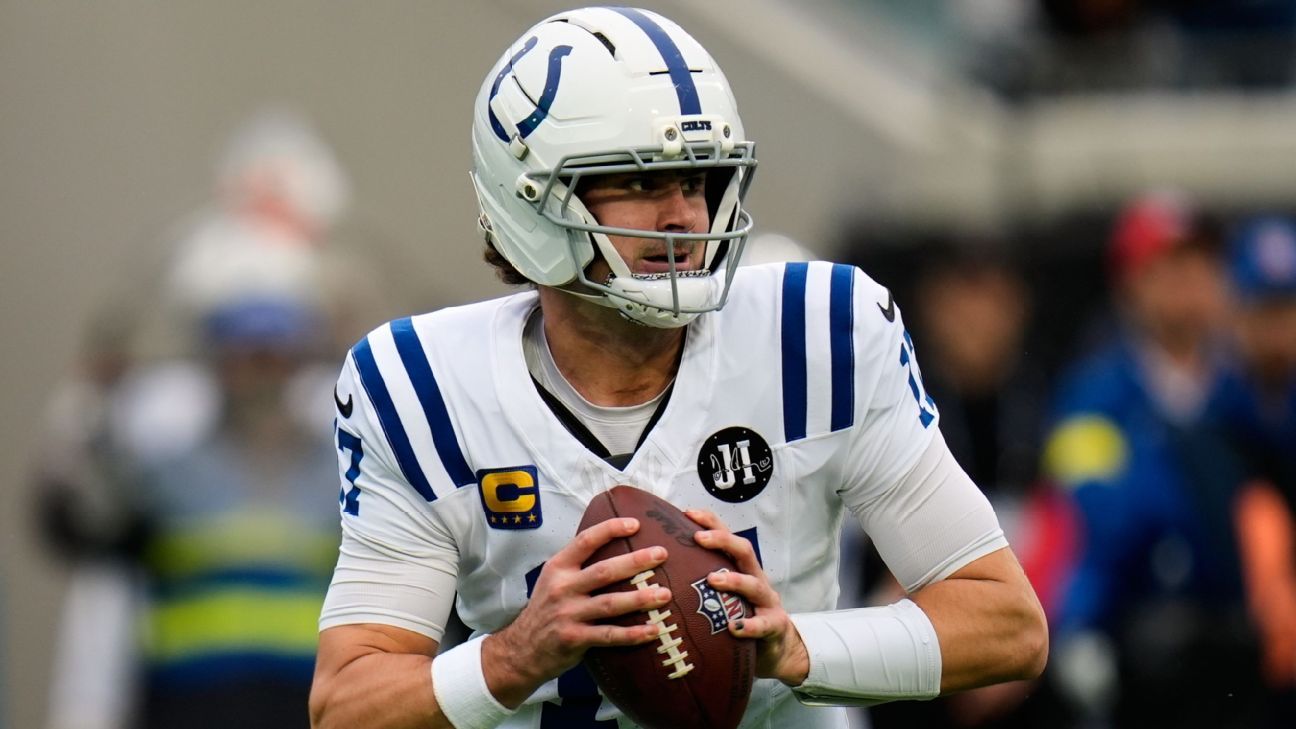
INDIANAPOLIS — Daniel Jones clutched his right leg, instantly grasping the seriousness of the situation. The Indianapolis Colts’ signal-caller, perhaps understanding that his right Achilles tendon had torn during the most successful season of his professional career, repeatedly slammed his headgear into the moist playing field in a demonstration of profound exasperation.
That particular incident, occurring on Dec. 7 in Jacksonville, now stands in stark contrast to a completely different scenario: Jones entering the Colts’ media room on March 12 — without assistance from crutches and showing no visible limp – ready to discuss the substantial two-year contract extension he had just signed.
The fact that the Colts presented Jones with a contract totaling a baseline of $88 million, potentially reaching $100 million through performance bonuses, merely three months following one of the most crippling sports injuries, certainly caused widespread surprise.
Nevertheless, Jones and the Colts appear undisturbed by the circumstances. The squad constructed its offseason game plan around retaining Jones and rekindling the offensive brilliance it discovered with him leading the charge in 2025. The franchise is proceeding under the conviction that Jones will be able to play as early as the inaugural game in 2026 and can replicate his performance from a year prior.
“His accomplishments before the injury were tremendous for our team,” stated coach Shane Steichen.
General manager Chris Ballard commented: “We are confident about his current state and his future trajectory.”
But are the Colts truly on firm footing here? Or are they adopting an overly optimistic perspective regarding an injury that could have extensive ramifications for athletes?
“It’s not outlandish to consider he might commence play for them on opening day,” offered Dr. Tim Kremchek, an orthopedic surgeon who also serves as medical director for the Cincinnati Reds.
Ultimately: Given what’s at stake, the Colts and Jones have approached this matter with utmost gravity. Jones’ operation was conducted by renowned surgeon Dr. Martin O’Malley, who additionally performed Achilles mends on NBA luminaries Jayson Tatum of the Boston Celtics and Tyrese Haliburton of the Indiana Pacers.
Tatum recently rejoined his team’s lineup less than ten months following his surgery after sustaining an injury in the previous season’s playoffs and has performed impressively. Basketball involves considerably more forceful movements and sharper directional changes than Jones would typically execute as a quarterback, Kremchek explained. That, he further elaborated, indicates it’s reasonable to anticipate Jones will have a quicker recovery period.
In a related point, O’Malley is among numerous medical professionals who utilize a more contemporary approach to Achilles repair. The technique involves a much smaller incision than was previously employed, thereby diminishing the probability of infection and other complications.
Another factor that provides the Colts with a degree of reassurance is the timing of their contract discussions with Jones. Jones and the Colts finalized an agreement on March 11, just as the period for signing free agents was about to commence. This was just over three months from the date of Jones’ Dec. 9 surgery, a crucial benchmark in Achilles recuperation.
“The three-month milestone signifies moving beyond the critical phase,” Ballard asserted.
Kremchek concurred.
“Three months represents the pivotal juncture,” he remarked.
At that point, the incision has fully mended (making infection improbable), range of motion starts to return, and the efficacy of the surgical procedure becomes more apparent. Physicians can then assess advancement more readily, offering peace of mind. Jones underwent examinations by O’Malley and team doctors before the contract was formally enacted and believed that proceeding was judicious.
An illustration of the importance of the three-month period can be observed with another NFL quarterback. Deshaun Watson of the Cleveland Browns did not reach the three-month mark in his recovery from an Achilles tear in 2024. He suffered a re-injury just beyond two months post-surgery and necessitated an additional procedure that considerably delayed his rehabilitation schedule.
“However, once you pass that three-month threshold, you’re quite secure,” Kremchek confirmed. “It becomes extremely difficult to harm them again after three months.”
Now that Jones is more than ninety days past his operation, his rehabilitation will begin to intensify. Strengthening exercises will be a primary focus and, soon, he can advance to light running. Some regulated football maneuvers might be achievable during spring offseason training, Kremchek mentioned, with Jones probably recommencing throwing passes around the five- or six-month mark.
An underestimated element in this entire situation is Jones’ approach to his recovery regimen. He has tackled it with relentless determination, remaining in Indianapolis this offseason to collaborate with the Colts’ medical personnel every day. Furthermore, Jones has explored every avenue, consulting with other quarterbacks who also endured Achilles tears to gather advice. Jones reached out to Aaron Rodgers immediately after his injury, seeking guidance on how to approach the recuperation. Rodgers sustained a ruptured Achilles in the first week of the 2023 season.
“It’s an ongoing journey, and there’s a considerable amount of effort required, and I’m prepared for it,” Jones stated.
Finally, precedent is in Jones’ favor. While the roster of prominent quarterbacks who have experienced Achilles tears is not extensive, there have been notable instances of successful comebacks.
The most celebrated instance might be Hall of Famer Dan Marino’s 1993 injury at the age of 32. (Jones is 28.) Marino overcame the affliction and had an outstanding season in 1994, accumulating 4,453 passing yards and 30 touchdowns.
Kirk Cousins, at 35, sustained an Achilles tear in Week 8 of the 2023 season while with the Atlanta Falcons and was able to participate with minimal restrictions in the team’s 2024 spring practice sessions. Rodgers, who famously tore his Achilles on the initial offensive series of the 2023 season with the New York Jets at 40 years old, remarkably made a partial return to practice merely 11 weeks post-surgery. The Jets ultimately chose not to play him until the subsequent season.
Can Jones join that distinguished group of quarterbacks who achieved positive outcomes after an Achilles tear? He believes he is making excellent progress.
“I’m in a favorable position,” Jones affirmed. “I believe I am maintaining my schedule … I’ve achieved my objectives and simply need to persist in doing so.
“I feel good about my current status.”