
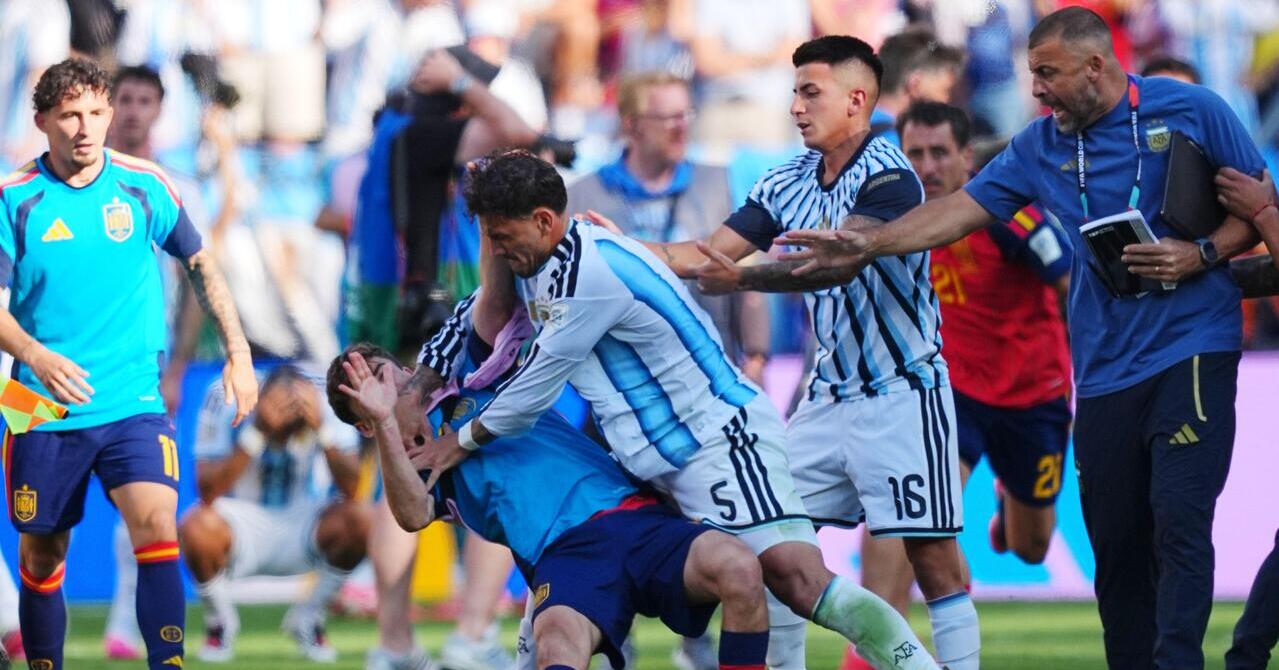
The roar of the crowd, the shower of confetti, the ecstatic jubilation of Spain – these were the indelible images meant to define the thrilling climax of the World Cup. Yet, beneath the veneer of triumph, a darker, more troubling narrative began to unfold, threatening to cast a long shadow over Spain’s hard-fought second World Cup title. The final whistle, usually a signal for celebration or commiseration, instead triggered a chaotic mêlée, culminating in ugly scenes that have ignited a global debate on sportsmanship, accountability, and the very spirit of the beautiful game.
The architects of this controversy were none other than a contingent of Argentina players, their raw, unbridled frustration boiling over in a truly shocking display of post-match aggression. At the epicentre of this maelstrom was Argentina’s Leandro Paredes, whose actions swiftly transitioned from competitive fire to outright assault. Eyewitnesses and countless replays confirm a volatile sequence: a lunge at Spain’s composed defender Eric Garcia, hands grasping menacingly at his throat, followed by a forceful, unwarranted shove that sent the young, dynamic Gavi sprawling to the hallowed turf. It was an appalling spectacle, a stark deviation from the expected decorum of a World Cup final, and one that demanded immediate, decisive action.
FIFA, the global governing body, has since confirmed it will open an investigation into Paredes’ conduct, a move that is both necessary and overdue. The images were clear, the intent seemingly malicious, and the potential repercussions for the image of the sport profound. However, in a twist of sporting magnanimity – or perhaps a display of the hardened reality within professional football – the victim himself, Spain’s effervescent midfield maestro Gavi, has weighed in with a surprising plea for leniency. Speaking to El Partidazo de COPE, the Barcelona star expressed a reluctance to see Paredes face a retrospective ban.
“I don’t think [Paredes] should be suspended,” Gavi told the Spanish radio programme. “I understand it’s not a good image for children, but I think there’s also that side to football, which is a bit more physical, more aggressive. The most logical thing would have been to send him off during the match, and that’s it. In the end, I think it’s all football, and it has to be that way.”
Gavi’s perspective offers a fascinating, albeit contentious, glimpse into the unwritten codes of the game. Is it a testament to Gavi’s own fiery spirit, recognizing a shared intensity that occasionally spills over? Or is it a pragmatic acknowledgment that such moments, however ugly, are an inherent, if regrettable, part of football’s DNA, best dealt with in the heat of the moment by the match official? His words resonate with a certain old-school mentality, where what happens on the pitch stays on the pitch, and where post-match retribution, even by authorities, is viewed with suspicion. Yet, his acknowledgment that it’s “not a good image for children” highlights the inherent conflict between the raw passion of the sport and its responsibility as a global role model.
The initial confusion surrounding referee Slavko Vincic’s handling of the incident only deepened the controversy. It was initially, and incorrectly, reported on FIFA’s commentator information system that Vincic had dismissed Paredes for his actions against Garcia. However, that red card was swiftly “deleted” thereafter, and it has since been confirmed that no disciplinary action was taken by the match official during the game. This perceived inaction on the field now thrusts the onus squarely onto FIFA’s disciplinary committee, raising critical questions about consistency, accountability, and the very integrity of the sport.
A post-match disciplinary sanction, while perhaps a deterrent, also raises questions about fairness when a player escapes punishment in real-time. Had Paredes been sent off, Argentina would have faced immediate consequences. Instead, he walked away, seemingly unpunished, and is now poised to play for Boca Juniors in their Copa Sudamericana clash against Chilean side O’Higgins. This immediate return to club action, before any FIFA ruling, underscores the urgency and importance of a swift, decisive investigation.
Game Highlights: Spain vs. Argentina – World Cup Final
The 1-0 extra-time victory for Spain was a masterclass in tactical discipline and individual brilliance, played out in an atmosphere crackling with tension. Here’s how the drama unfolded:
- Early Dominance, Spain:Spain, true to their identity, dominated possession from the outset, with Pedri and Rodri orchestrating intricate passing moves in midfield. Argentina, however, were compact and disciplined, soaking up pressure and looking to hit on the counter through the pace of Di María and the genius of Messi.
- Argentine Counter-Threats:The first real scare for Spain came in the 28th minute when Lautaro Martinez broke free, only to be denied by a superb sliding tackle from Aymeric Laporte inside the box. Messi then forced a brilliant diving save from Unai Simon with a trademark free-kick just before halftime.
- Second Half Stalemate:The second half saw both teams trade blows. Spain’s Marco Asensio rattled the crossbar with a powerful strike from distance in the 65th minute, while Emiliano Martinez pulled off a miraculous save to deny Dani Olmo from close range a few minutes later. Argentina’s defensive resilience, coupled with Spain’s inability to find the killer pass, pushed the game into extra time.
- The Decisive Moment (108th Minute):With penalties looming, Spain finally broke the deadlock. A moment of pure magic from Pedri saw him weave through two Argentine defenders before slotting a perfectly weighted pass to the onrushing Nico Williams. The winger, with ice in his veins, took a touch to set himself before unleashing an unstoppable shot into the top corner, sending the Spanish bench into raptures and clinching their second World Cup trophy.
- Final Whistle and Turmoil:Argentina pushed desperately for an equalizer in the dying minutes, but Spain held firm. The final whistle, however, dissolved into chaos as Argentine frustration boiled over, leading to the ugly confrontation involving Paredes, Garcia, and Gavi.
Prediction: The Unfolding Saga
FIFA faces a significant challenge with the Paredes incident. Given the clear visual evidence and the potential damage to the sport’s image, it is highly improbable that he will escape without sanction. While Gavi’s call for leniency is noteworthy, FIFA’s mandate extends beyond individual player sentiments to upholding the integrity and disciplinary standards of global football. I predict Paredes will receive a suspension, likely for a handful of international matches, possibly accompanied by a substantial fine. This will send a clear message that such behaviour, particularly in a showpiece event like the World Cup final, is unacceptable, regardless of the emotional intensity of the moment or the referee’s oversight. Furthermore, this contentious ending, far from fading into obscurity, will undoubtedly fuel the burgeoning rivalry between these two footballing titans, ensuring that future clashes will carry an added layer of intensity, perhaps even animosity, making for an even more compelling spectacle.