
**Key Takeaways**
- The Chevrolet Silverado EV delivers a surprisingly car-like driving experience with exceptional utility, boasting a 400+ mile range, spacious cabin, and innovative features like a mid-gate and bidirectional charging.
- Despite its impressive capabilities and competitive pricing (for its class), the Silverado EV faces significant sales challenges, likely due to market inertia, range anxiety, and charging concerns among traditional truck buyers rather than just price or towing capacity.
- GM is exploring future enhancements, including new battery chemistry (LMR) to cut costs and potential engineering refinements to reduce weight, aiming to achieve price parity with fossil fuel counterparts and better address market resistance.
Growing up, my automotive education involved shifting gears for my dad’s Chevrolet S-10 pickup from the passenger seat. Yet, despite that early exposure, I’ve never considered myself Chevy’s target demographic for a truck. My preferences lean towards the practicality and nimbleness of hatchbacks, a far cry from the raw utility of a cargo bed. So, when I embarked on a day of tooling around Detroit in the Silverado EV, I approached it with a healthy dose of skepticism. What I discovered, however, completely upended my preconceptions: Chevy might just be on the verge of making a truck guy out of me.
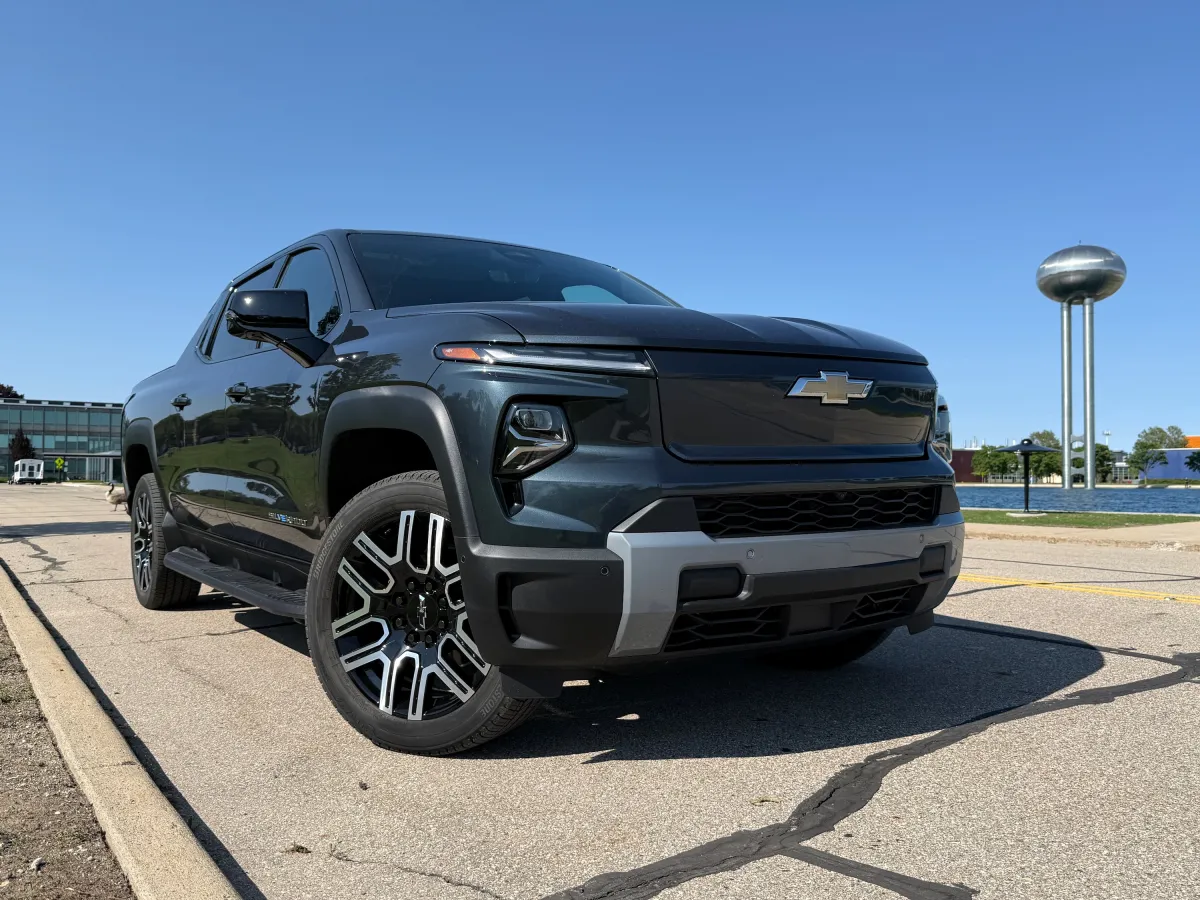
The Silverado EV isn’t just another electric vehicle; it’s a revelation. It drives with an agility and refinement that belies its imposing size, feeling almost like a car. Yet, it sacrifices none of the expected truck functionality. Its bed is massive, the frunk cavernous, and the back seat offers ample room for my notoriously long legs. The cabin is an oasis of quiet, capable of powering your home during an outage, hauling heavy loads, towing substantial trailers, and navigating highways with an uncanny hands-free autonomy. All this, while boasting an impressive range of over 400 miles on a single charge. On paper, it sounds like the dream combination for the quintessential American pickup lover.
And yet, this technological marvel isn’t exactly flying out of showrooms. GM managed to sell approximately 14,000 units last year across the U.S. and Canada—a stark contrast to its fossil fuel counterpart, which moves ten times that volume in a single quarter. After experiencing the Silverado EV firsthand, I’m genuinely stumped. GM appears to have crafted what could be the perfect American EV truck, but the market simply isn’t buying it.
The Silverado EV Experience: Blurring the Lines
Stepping into the Silverado EV requires a significant climb, a testament to its full-size truck stature. But once inside, the impression is one of expansive comfort and modern design. The cabin is remarkably spacious, offering a panoramic view through its large windows. Pressing the brake brings the vehicle to life, with crisp, vibrant screens immediately dominating the lower third of your vision, providing all necessary information with clarity. The seats are exceptionally supportive, designed for long hauls, and like many EVs, the Silverado EV responds to a prod of the right foot with an exhilarating surge of power. At nearly 20 feet long, it’s undeniably a behemoth, yet thanks to its sophisticated rear-wheel steering system, it navigates tight turns and weaves through parking lots with surprising grace—until, of course, you attempt to squeeze it into a standard-sized parking space.
The visual design is perhaps one point of contention. At first glance, the Silverado EV evokes memories of the old Chevy Avalanche, a design choice that garners mixed reactions. Like the Avalanche, it features four doors, a short bed that innovatively extends into the cabin via a “mid-gate,” and a distinctive “sail” panel connecting the cabin to the bed. This stylistic flourish isn’t just for show; it actively helps minimize aerodynamic drag, contributing to its impressive range. For me, someone not deeply ingrained in truck aesthetics, I found the look perfectly acceptable, if not striking.

Tech & Assistance on Board
The infotainment system, powered by Google, is a standout feature. Its screens are crisp, clear, and commendably responsive, almost matching the fluidity of an iPhone. Voice commands work seamlessly, integrating well with the Google ecosystem. Crucially, Chevy has maintained a sensible approach to controls, retaining physical knobs for volume and temperature, along with dedicated HVAC buttons below the vents. This blend of cutting-edge digital interface and tactile physical controls is a welcome relief, reminding us that intuitive design doesn’t always mean going fully digital.

Navigation, being a Google service, is inherently robust and user-friendly. When I dictated my destination, the system promptly offered multiple route options, much like Google Maps on a smartphone. However, it added a unique twist: alongside the estimated time to destination, it displayed an estimate of how long Super Cruise, GM’s advanced hands-free driving system, could be utilized on each route. This clever integration allows drivers to prioritize routes that maximize hands-free driving, a subtle but effective argument for GM’s controversial decision to forgo Apple CarPlay in its EVs. While I don’t fully agree with the exclusion of CarPlay, this feature at least offers a compelling use case for GM’s proprietary system.

Speaking of Super Cruise, GM’s Level 2 advanced driver assistance system lives up to its reputation. My previous brief encounter with Super Cruise in the Bolt left me impressed, but my extended time in the Silverado EV traversing the bustling Detroit metro area during peak commuting hours truly solidified its value. For a truck of this magnitude, Super Cruise transforms what could be a taxing drive into a remarkably stress-free experience. The system capably maintains speed and lane position, allowing the driver to relax and focus more on the road ahead rather than the constant micro-corrections typically required.
However, it wasn’t entirely without its quirks. Keeping the massive truck perfectly centered in its lane sometimes felt like a slight chore, requiring more attentiveness than expected. And similar to my experience in the Bolt, Super Cruise occasionally struggled with other vehicles aggressively cutting in from the right. There was one particularly unsettling moment when the Silverado EV nearly collided with a heavily paint-splattered trailer. While the paint-obscured taillights might have confused the camera system, the radar should have unequivocally detected the obstacle. Despite these minor hiccups, Super Cruise significantly smoothed the overall journey, contributing to a driving experience that felt surprisingly serene for such a large vehicle.
Performance & Efficiency
A significant contributor to the Silverado EV’s smooth, composed ride is its massive 205 kilowatt-hour battery pack, strategically positioned midships. This colossal power source doubles as an exceptional ballast, anchoring the truck to the road and dampening vibrations. Kudos must also go to the ride and handling engineers, who clearly poured immense effort into tuning the suspension and chassis. As trucks go, the Silverado EV’s ride quality is exceptionally refined, closer to a luxury SUV than a traditional pickup.
Even more impressive was the efficiency clocked during my drive. I observed approximately 2.1 miles per kilowatt-hour, which is only about 10% to 20% less efficient than what I typically achieve in my Audi e-tron—a significantly smaller vehicle with a much lower frontal area pushing against the wind. For a truck of its size and capability, this level of efficiency speaks volumes about GM’s engineering prowess and the aerodynamic benefits of design elements like the aforementioned “sail.”
The Sales Enigma: Why Aren’t Buyers Biting?
The core question remains: why are sales so slow for such a compelling vehicle? Many observers are quick to point fingers at the Silverado EV’s price tag, but I find that argument unconvincing. Full-size pickup buyers, on average, shell out around $66,000 for their trucks. The Silverado EV LT Extended Range, offering an impressive 410 miles on a full charge, lists for just $5,000 more. The LT Max Range, which I tested and provides an additional 68 miles, does jump up by $20,000, but even that is within the realm of premium truck configurations. It’s hard to argue that a $5,000 premium for significantly lower running costs and a superior driving experience is a dealbreaker for a segment accustomed to high prices.
Another frequently cited reason is the EV’s reduced towing range, often cited as being 60% shorter than its gasoline counterparts. Again, this shouldn’t be a widespread deterrent. According to Strategic Vision, a staggering 75% of full-size truck owners tow at most once per year. This suggests a massive addressable market of approximately 400,000 fossil fuel-powered Silverado buyers who, based on their usage patterns, should be prime candidates for an electric switch. And yet, the sales figures tell a different story.
It appears that GM, along with other automakers, fundamentally misjudged the deeply ingrained habits and perceptions of the truck market. This segment, more than most, suffers from a profound sense of inertia—and not the kind related to piloting a 4.5-ton vehicle. Potential buyers are plagued by anxieties surrounding range, the accessibility and speed of charging infrastructure, and likely numerous other unspoken concerns rooted in decades of traditional truck ownership. These anxieties have broadly hampered EV adoption, but they appear to be particularly acute within the pickup truck segment, hindering the Silverado EV’s uptake despite its objective merits.

Paving the Road Ahead: Future Prospects
It’s a real shame, as many of the concerns that plague potential buyers tend to “melt away” after experiencing EV ownership for a while. The Silverado EV, even in its current form, is a remarkably solid first draft of an electric pickup truck. With further engineering refinements, GM could potentially wring more weight out of the vehicle, which would directly boost its payload and towing capacities. Simultaneously, a lighter platform could allow for a smaller battery pack without sacrificing range, thereby significantly cutting manufacturing costs.
GM is already hinting at addressing the cost issue head-on, potentially sooner rather than later. The automaker has strongly suggested that the Silverado EV will eventually receive an entirely new battery chemistry: lithium-manganese-rich (LMR). This innovative technology promises to slash costs by approximately $6,000 per vehicle while maintaining the impressive range. If these savings are genuinely passed on to the consumer, it would bring the Silverado EV to near price parity with its fossil fuel equivalent, a crucial step in overcoming market resistance.
If such revisions come to fruition and effectively lower the price point, I could genuinely envision myself considering a Silverado EV. The only remaining hurdle? Its sheer size. It’s simply too massive for my 1950s-era two-car garage. To accommodate this impressive machine, I’d need to upgrade to a bigger house. And honestly, what could be more quintessentially American than that?
Bottom Line
The Chevrolet Silverado EV stands as a testament to impressive engineering, offering a compelling blend of car-like refinement, robust truck utility, advanced technology, and exceptional range. It’s a vehicle that, on its merits, should be a runaway success, particularly for a segment often willing to pay a premium. However, deep-seated market inertia, exacerbated by pervasive range anxiety and charging concerns, continues to hobble its sales performance. While GM has crafted a truly groundbreaking electric pickup, its real challenge lies not in further innovation, but in shifting deeply ingrained consumer perceptions and demonstrating that the future of the American truck is, indeed, electric.
When you purchase through links in our articles, we may earn a small commission. This doesn’t affect our editorial independence.
{content}
Source:{feed_title}