
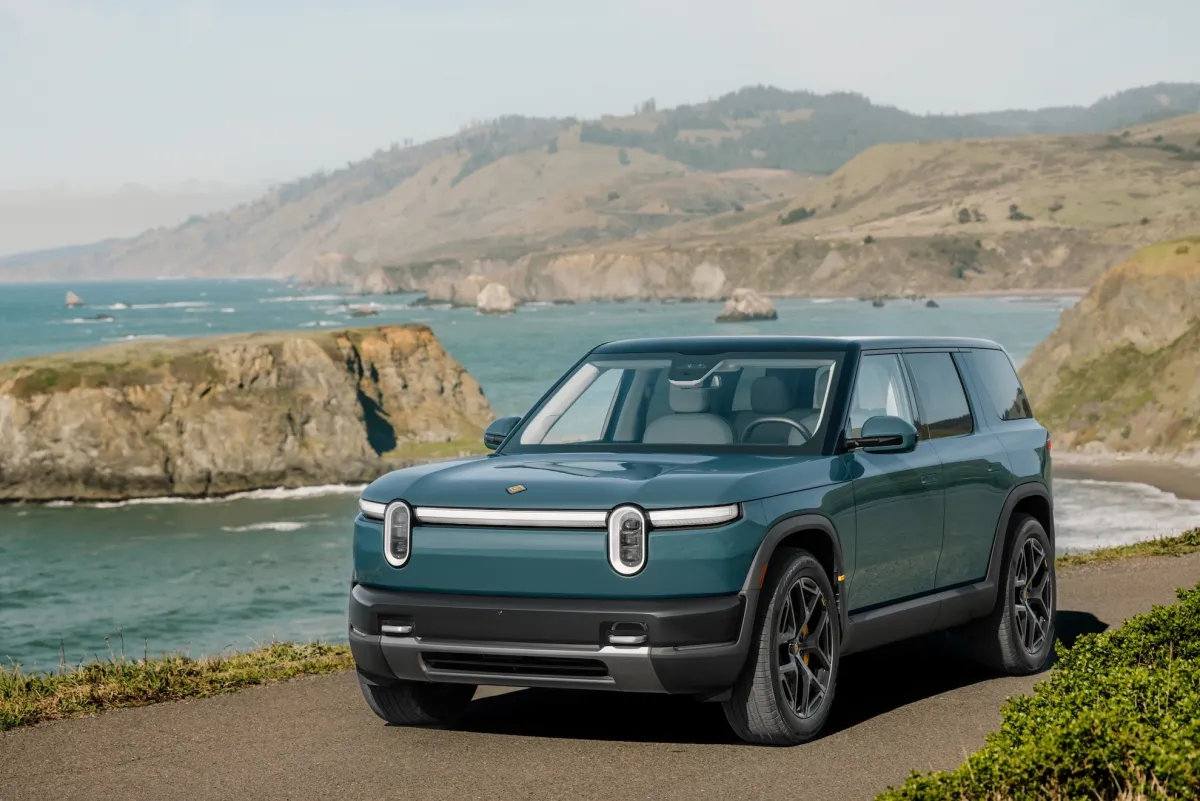
Two years after unveiling what its cost-effective, future-gen EV would appear like, Rivian has disclosed comprehensive details regarding the pricing, available hues, and operational specifications for its forthcoming R2 SUV. And, much like numerous fresh vehicle introductions, the situation is intricate.
In essence: Rivian’s endeavor to offer a more budget-friendly EV that is accessible to a wider consumer base will be priced from $45,000 to $57,990 — these figures fluctuate according to performance and other internal and external embellishments.
Rivian will ultimately provide patrons with multiple iterations of its R2 medium-sized sport utility vehicle. However, the initial variant accessible to purchasers this spring will be its priciest. The R2 Performance with the Launch Package variant, an electric vehicle featuring dual motors and all-wheel drive with an approximate EPA range of up to 330 miles, will commence at $57,990. Rivian will later discontinue the ‘launch edition’ designation and merely market a performance variant, though it has not disclosed its price specifics as of yet.
Rivian announced plans to commence manufacturing and distribution of a premium version of the R2 — likewise a dual-motor AWD SUV with reduced engine power, but the identical 330-mile operational distance — towards the close of 2026, with a starting price of $53,990.
The vehicle manufacturer will subsequently provide two distinct baseline models of the R2 — with the main distinction resting in battery capacity. The “long range” standard R2 is anticipated to enter manufacturing in early 2027, boasting a 345-mile reach and an initial cost of $48,490. A more economical $45,000 base model offering an approximate 275-mile driving distance is slated for production sometime in late 2027, Rivian said.
It is uncertain if Rivian will ultimately produce that $45,000 version, and this will probably hinge upon how the preliminary launch of its pricier models fare.
Typical Features
Significantly, Rivian is quite consistent across all specifications regarding fundamental characteristics. All of the R2 variants are constructed upon Rivian’s novel medium-sized architecture that incorporates internally developed and produced motors. They all include an 87.9 kilowatt-hour battery unit and an integrated North American Charging Standard outlet — specifically, the connector pioneered by Tesla. The battery ranges, too, are quite similar within the R2 variants, save for the most economical R2 base model.
Techcrunch event
San Francisco, CA
|
October 13-15, 2026
The specifications alter, nevertheless, upon examination of horsepower and torque figures. The performance launch edition is the swiftest and most proficient. The dual-motor all-wheel drive model provides an output of 656 horsepower and 609 pound-feet of torque and is able to accelerate from 0 to 60 mph in a mere 3.6 seconds. (Though it’s unlikely a driver of a medium-sized SUV would require such rapid acceleration from a standstill.)
Rivian reduces the intensity with the upscale variant, which also features dual-motor all-wheel drive, but this one only generates a lesser 450 horsepower and 537 lb-ft of torque. And that results in a more leisurely 4.6-second sprint from zero to 60 mph.
Lastly, the base long-range model features rear-wheel drive that delivers 350 horsepower and 355 lb-ft of torque. This particular iteration benefits from an extended range of 345 miles. It exhibits a slower initial acceleration, completing 0 to 60 mph in 5.9 seconds. (Rivian has not yet divulged the specifications for its most economical R2.)
The Rivian R2 SUV is arguably a pivotal model for the automaker — and one that the manufacturer has set substantially ambitious sales targets for this year. It has to be sufficiently enticing to captivate buyers, without deterring them with an exorbitant cost. And it has to be more economical to produce than its premier model, should it aim for eventual profitability.
For Rivian, that ideal price point fluctuates somewhat, but primarily exceeds $50,000. However, whether this aligns with consumers’ ideal price range is a different concern. The typical new vehicle purchaser expended $49,191 in January, as per Kelly Blue Book. Consequently, the R2 is positioned slightly above that median cost — and notably prior to purchasers incorporating any supplementary features to their personalized vehicle.
Furthermore, numerous chances to incorporate enhancements will be available.
Enhancements for all

Potential R2 purchasers will be presented with a multitude of options to customize their electric vehicle. And each selection incrementally increases the cost. As an illustration, every EV variant includes a novel standard hue termed Esker Silver.
Should a purchaser desire an alternative paint shade, such as the distinctive “launch green” for the debut edition, an additional charge will apply. Rivian is debuting a total of three fresh colors, namely, silver, a metallic blue designated Catalina Cove, and a metallic grey referred to as Half Moon Grey. It will additionally permit customers to select from its pre-existing color palette.
Customers who select the pricier performance launch edition and upscale models will receive the greatest array of supplementary features, comprising a 9-speaker, 2-midwoofer sound system, warmed and cooled front seating, warmed outer rear seating, a heated steering mechanism, and 12-way adjustable seating. Both of these specifications will similarly feature a novel interior as standard, adorned with what Rivian terms birch wood flourishes. And both will incorporate a torch flashlight within the driver’s door, an homage to one of the initial delightful additions in its premium R1 truck and SUV.
Though each new R2 will be equipped with standard advanced driver assistance functionalities, opportunities for enhancement exist. Rivian Autonomy+, providing autonomous driving capabilities on specific roadways, can be acquired for a singular payment of $2,500 or a monthly charge of $49.99. This particular feature is bundled for individuals who opt for the premium performance launch edition.
{content}
Source:{feed_title}