
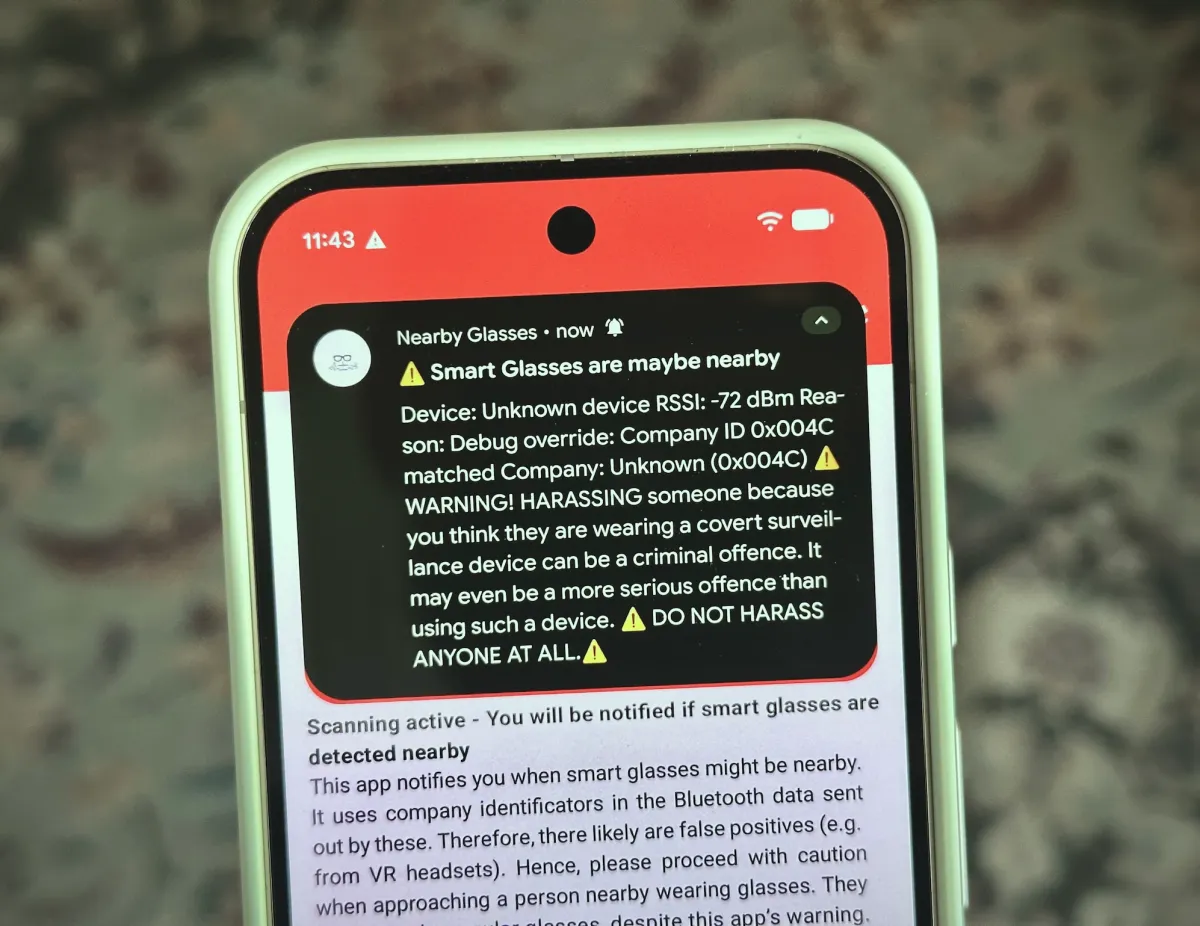
A significant concern regarding opulent monitoring gadgets, such as intelligent spectacles featuring integrated video recording lenses, is their frequent resemblance to standard eyeglasses, which means individuals could be filmed unknowingly.
Yet, an application has emerged capable of identifying and notifying you if a person in your vicinity is wearing smart glasses, or perhaps other continuously recording technology.
This Android application, suitably designated Nearby Glasses, continuously seeks out close-range transmissions emanating from Bluetooth-capable technology, including portable gadgets manufactured by Meta (and Oakley) and Snap.
The application’s debut occurs amidst escalating opposition to perpetually capturing or audibly monitoring gadgets, which detractors claim analyze details concerning nearby individuals who have not offered their permission.
Yves Jeanrenaud, the application’s creator, initially conversed with 404 Media concerning the undertaking, mentioning he was partly motivated to develop Nearby Glasses after reviewing the independent publication’s investigations into portable monitoring gadgets, encompassing instances where Meta’s Ray-Bans smart glasses were deployed during immigration operations and for recording and disturbing sex workers.
Within the application’s project documentation, Jeanrenaud characterized intelligent spectacles as an “unbearable trespass, permission disregarding, dreadful gadget.”
Jeanrenaud communicated to TechCrunch via electronic mail that his impetus originated from “observing the vast extent and cruel character of the misuse associated with these smart glasses.” He further referenced Meta’s choice to integrate facial identification as a standard capability in its smart glasses, “which I perceive as a significant barrier removed for various forms of privacy-encroaching conduct.”
The app operates by monitoring for proximate wireless transmissions featuring a universally designated marker specific to the producer of the Bluetooth apparatus. Should the application pinpoint a Bluetooth transmission originating from a proximate Meta or Snap hardware item, it will dispatch a notification to the user. (The app also enables individuals to incorporate their distinct Bluetooth tags, thereby empowering the user to identify a wider array of portable monitoring equipment.)
Jeanrenaud indicated the application might be susceptible to erroneous detections. Consequently, the application might identify a proximate Meta-produced virtual reality headgear and notify the user, presuming it to be intelligent spectacles fashioned by the same equipment manufacturer. Nonetheless, VR headgear typically presents as bulkier and more apparent to an observer that it is being worn.
For experimental purposes, I installed the application onto an Android handset and strolled through my urban district’s vicinity, discovering (unexpectedly) an absence of intelligent eyewear users, and consequently received no notification.
Yet, given the app’s capability, I incorporated a particular Bluetooth marker (0x004C), enabling me to seek out proximate Apple-manufactured gadgets — and my experimental apparatus was instantly inundated with notifications (predictably), probably detecting every Apple-produced item in my immediate vicinity.
This demonstrated that the application functions according to its conception.
Jeanrenaud continues to incorporate novel functionalities and notes a call for an iPhone application, however, this hinges upon leisure time and accessibility.
Commenting on the application, Jeanrenaud stated: “Naturally, it represents a technological remedy for a societal issue (a problem exacerbated by technological advancements), and this issue is unlikely to vanish in the near future,” and he characterized the application as a “valiant stand of defiance, with the hope of aiding even a single person.”
Representatives from Meta and Snap failed to answer TechCrunch’s inquiries for remarks.
{content}
Source:{feed_title}