
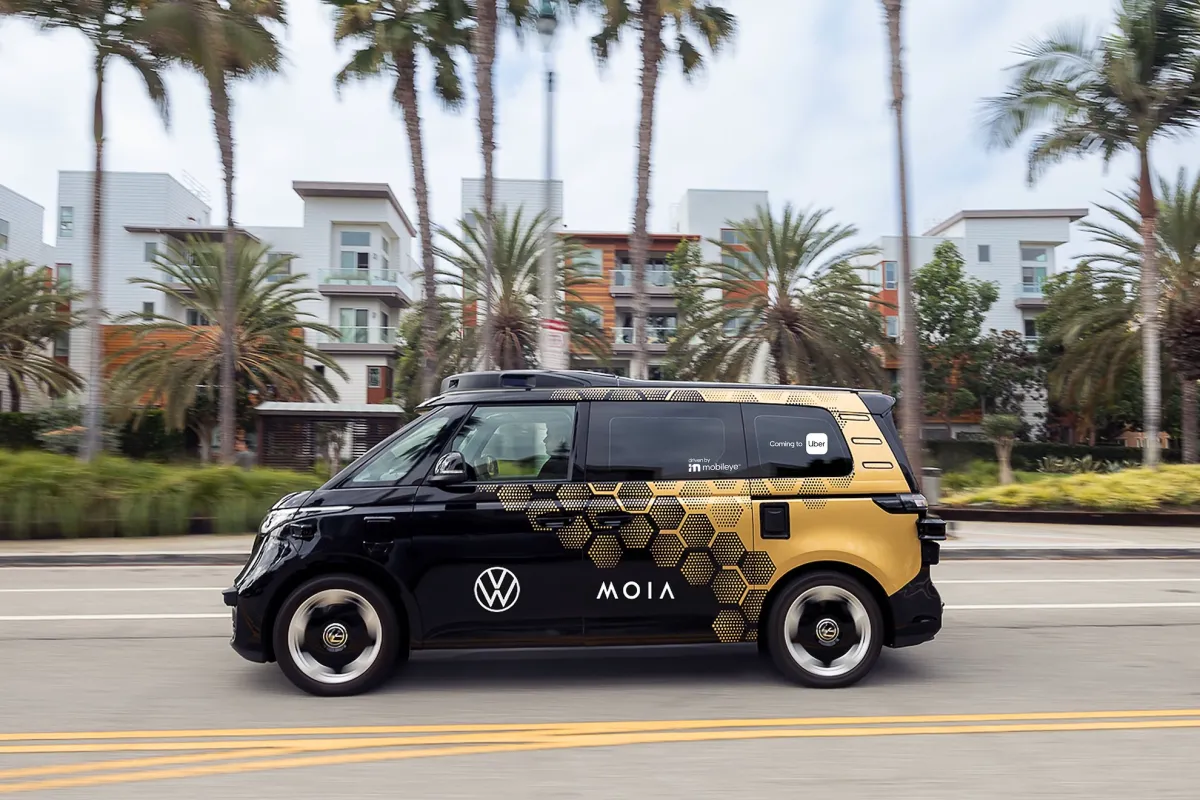
Volkswagen subsidiary MOIA America and Uber have started testing autonomous microbuses in Los Angeles, the companies announced Wednesday, the latest step as they prepare to launch a robotaxi service by late 2026.
Key Takeaways
- L.A. Robotaxi Testbed:Volkswagen’s MOIA America and Uber have commenced testing autonomous ID. Buzz microbuses in Los Angeles, marking a critical phase toward their goal of launching a commercial robotaxi service by late 2026.
- Phased Deployment & Scale:Initial testing involves around 10 ID. Buzz vehicles with human safety operators. The plan includes scaling to over 100 autonomous vehicles and transitioning to fully driverless operations by 2027, highlighting a methodical approach to deployment.
- Uber’s Diversified AV Play:This partnership is one facet of Uber’s extensive autonomous vehicle strategy, which includes over 25 collaborations globally, notably a recent $300 million investment in Rivian for 10,000 R2 robotaxis targeting 2028 deployment in San Francisco and Miami.
Volkswagen-Uber Alliance Accelerates Autonomous Microbus Rollout in Los Angeles
The bustling streets of Los Angeles are set to become a proving ground for the future of urban mobility as Volkswagen subsidiary MOIA America and ride-hailing giant Uber officially kick off testing for autonomous microbuses. Announced Wednesday, this joint venture represents a significant stride towards their ambitious goal of launching a full-fledged commercial robotaxi service by late 2026, building upon a strategic partnership unveiled just a year prior.
Los Angeles, a city synonymous with automotive culture and a penchant for embracing technological innovation, has been strategically chosen as the inaugural market for this deployment. The initial phase will see approximately 10 autonomous versions of Volkswagen’s all-electric ID. Buzz minivan navigating select L.A. routes. These production-ready driverless vehicles are designed to comfortably seat four passengers, offering a glimpse into the ride experiences of tomorrow.
Paul DeLong, president of commercialization at MOIA America, underscored the market’s suitability, stating, “given its long history of shaping car culture and embracing new mobility technologies,” Los Angeles provides an ideal backdrop for introducing their autonomous fleet. The partnership has already established a dedicated joint facility in the city, serving as the operational hub for day-to-day fleet management and development.
While the current test fleet is modest, Volkswagen has outlined plans for substantial expansion, aiming to scale to more than 100 autonomous ID. Buzz vehicles. Importantly, the initial testing will proceed with a human safety operator onboard each vehicle, a common practice in the nascent stages of autonomous deployment to ensure safety and gather critical data. The transition to fully driverless operations, where vehicles operate without any human intervention, is slated for 2027.
Sascha Meyer, Chief Commercial Officer for Volkswagen Autonomous Mobility, echoed the enthusiasm, emphasizing that this latest development “reflects the strong momentum behind the strategy to bring autonomous mobility into real-world operation.” This progressive, phased approach underscores the companies’ commitment to rigorous testing and safety protocols before a broader commercial rollout.
The branding itself signals a strategic consolidation. MOIA America is the relatively new moniker for Volkswagen’s U.S. autonomous vehicle initiatives, previously known as Volkswagen ADMT. The MOIA brand, however, has a longer lineage, originating in 2018 at TechCrunch Disrupt London. It’s a familiar name in Europe, particularly known for its ride-pooling services and extensive autonomous vehicle testing in major cities like Hamburg, Berlin, Munich, and Oslo. This rebranding aims to forge a clearer connection and synergy between Volkswagen’s U.S. and European autonomous mobility ventures, leveraging established expertise across continents.
Techcrunch event
San Francisco, CA
|
October 13-15, 2026
Navigating the complex regulatory landscape remains a critical hurdle for MOIA America. Before it can launch a commercial robotaxi service – essentially, driverless vehicles charging passengers for rides – in California, the company must secure a series of stringent permits. This includes approvals from the California Department of Motor Vehicles (DMV), which governs autonomous vehicle testing and deployment, as well as a ride-hailing permit from the California Public Utilities Commission (CPUC). The Golden State has one of the most comprehensive, and often challenging, regulatory frameworks for autonomous vehicles, demanding extensive safety data and operational transparency.
Uber’s Multi-Faceted Autonomous Strategy: Hedging Bets for Future Mobility
While the MOIA partnership represents a significant front, it’s crucial to view this development within the broader context of Uber’s expansive and deliberately diversified autonomous vehicle strategy. The ride-hailing behemoth has adopted a multi-pronged approach, spreading its bets across an impressive portfolio of over 25 companies. These collaborations span various applications of autonomous technology, from delivery services and drones to ride-hailing and long-haul trucking, showcasing Uber’s commitment to remaining at the forefront of future mobility solutions.
In the U.S., Uber’s most visible and long-standing autonomous vehicle partnership is with Waymo, Google’s self-driving car company, which has been operating commercial services in select cities. Beyond domestic alliances, Uber has strategically extended its AV ambitions globally. The company has forged agreements with several prominent Chinese autonomous driving companies, aiming to launch robotaxi services in key markets across Europe and the Middle East. Furthermore, it has invested in innovative startups like the U.K.-based Wayve, which focuses on deep learning for autonomous vehicles.
Perhaps the most recent and impactful demonstration of this diversified strategy is Uber’s substantial agreement with electric vehicle manufacturer Rivian. This deal entails Uber committing to purchase 10,000 of Rivian’s upcoming R2 robotaxis, a move anticipated to precede a planned rollout in major U.S. cities like San Francisco and Miami by 2028. To cement this partnership and accelerate development, Uber is making an initial investment of $300 million in Rivian. This blend of in-house development, strategic partnerships, and significant financial commitments highlights Uber’s determination to integrate autonomous technology seamlessly into its global ride-hailing and logistics network, ensuring it’s positioned to capitalize on whichever autonomous solution ultimately scales successfully.
The launch of MOIA America and Uber’s L.A. testing is more than just a local pilot; it’s a piece in a much larger global puzzle. As regulatory bodies adapt and technology matures, these initial deployments will provide invaluable data and insights, shaping not only the companies’ strategies but also the public’s perception and acceptance of driverless vehicles. The race to dominate the autonomous mobility sector is intensifying, and partnerships like this one are vital for maintaining a competitive edge.
The Bottom Line
The initiation of autonomous microbus testing in Los Angeles by Volkswagen’s MOIA America and Uber represents a tangible, forward step in the commercialization of robotaxi services. While the late 2026 target for launch is ambitious, the methodical, phased approach—starting with safety operators and scaling up—demonstrates a pragmatic commitment to safety and development. For Uber, this partnership further solidifies its extensive, multi-vendor autonomous strategy, positioning it to adapt and thrive regardless of which specific AV technology or partner ultimately achieves widespread market penetration. The journey from pilot to pervasive driverless mobility remains fraught with technological and regulatory complexities, but the wheels are undeniably in motion.
{content}
Source:{feed_title}