
Unlock the Editor’s Digest for free
Roula Khalaf, Editor of the FT, selects her favourite stories in this weekly newsletter.
Key Takeaways
- Strategic Market Penetration:The Ultimate Fighting Championship (UFC), a key asset of TKO Group Holdings, is making significant investments to deepen its presence in the burgeoning Chinese sports entertainment market, signaling a long-term commitment to a crucial growth geography.
- “Local Hero” Growth Catalyst:UFC’s strategy hinges on cultivating homegrown talent like Song Yadong and Zhang Weili, mirroring successful models seen in other sports (e.g., Yao Ming in NBA) to rapidly expand its domestic fanbase, viewership, and unlock higher media rights valuations.
- Revenue Diversification & Valuation Uplift:The expansion in China is poised to diversify TKO’s revenue streams through enhanced media rights, sponsorship deals, and merchandise sales, potentially offering a significant upside to the company’s valuation as it captures a larger share of the world’s most populous market.
The Ultimate Fighting Championship (UFC) is aggressively building on its strategic presence in China, as the global combat sports giant, a crown jewel of TKO Group Holdings (NYSE: TKO), recently hosted a record-breaking fight night in the country. This move underscores a calculated effort to tap into one of the world’s largest and most dynamic consumer markets, directly impacting TKO’s growth trajectory and investor outlook.
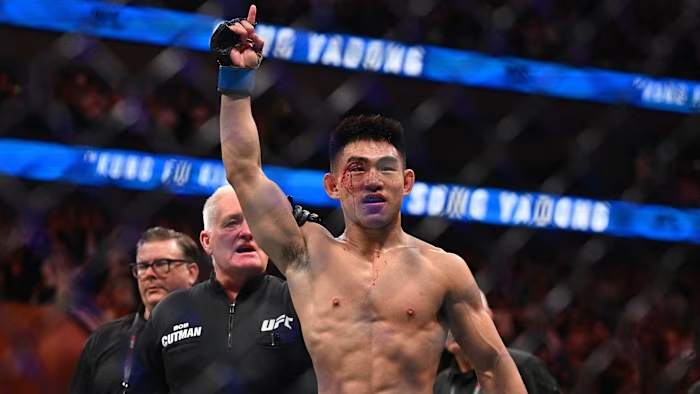
More than 16,000 enthusiastic fans flocked to last weekend’s UFC event in Shanghai, marking the highest attendance for any UFC spectacle previously held on Chinese soil. The event culminated in a surprise knockout victory for homegrown bantamweight star Song Yadong, a moment that resonated deeply with the local audience and amplified the potential of the “local hero” strategy.
Having held its inaugural mainland China event in 2017 and returning to Shanghai last year post-Covid-19 disruptions, the UFC is now firmly betting on exponential audience growth. This confidence is rooted in China’s rich, millennia-long history of martial arts, from the internationally revered kung fu popularized by Bruce Lee to indigenous forms like Sanda kickboxing. This cultural alignment provides a fertile ground for mixed martial arts (MMA) to flourish.
“We’re making our way back, and our intention is certainly to have this consistent presence and schedule as far as events are concerned,” stated Kevin Chang, vice-president and head of Asia for UFC. Chang emphasized the organization’s renewed focus, adding that the sport was “re-establishing that mission” in China and that “We just have a lot more to talk about these days,” hinting at expanding commercial opportunities and partnership discussions.
The Las Vegas-based UFC, a pivotal component of the Endeavor-owned TKO Group Holdings, is often associated domestically with America’s “Maga” movement, an association highlighted by a special event held on the White House lawn in June attended by former President Trump. However, the promotion company’s global footprint stretches far wider, from its established strongholds in Brazil to its growing influence in the Middle East. China represents an imperative strategic market, offering a vast viewership that global sports franchises, from Formula 1 to golf, have long sought to penetrate.
In a tangible demonstration of its long-term investment strategy, the UFC launched a state-of-the-art 92,000 sq ft Performance Institute in Shanghai in 2019. This facility, the first of its kind outside of Las Vegas, is a crucial infrastructure investment designed to nurture local talent. Currently, the UFC boasts 20 fighters from China within its extensive roster of hundreds of athletes, approximately half of whom originate from outside the US. This investment in local talent is a direct pipeline to future revenue growth, transforming raw potential into marketable sports stars.
“Our goal is to really see the proliferation of Asian martial arts and Chinese mixed martial artists, you know, succeed in the UFC,” Chang articulated, underscoring the strategic imperative of creating local champions.
Song Yadong, a 28-year-old from Harbin in northern China, embodies this strategy. His entry to the ring last weekend was met with a thunderous ovation from the Shanghai crowd, a roar that escalated exponentially minutes later as he delivered a stunning knockout of the odds-on favourite, Umar Nurmagomedov of Russia, in the second round. His post-fight exclamation, “hai you shei[who else]?”, became an instant rallying cry, symbolizing national pride and athletic prowess.

The precedent for such an impact was set by Zhang Weili, a female fighter in the strawweight division, who became the first Chinese UFC champion in 2019. Her victory, as Chang noted, marked a “turning point” for the sport in China. The UFC currently commands a robust 18 million followers on social media within the country, a testament to its growing digital footprint and fan engagement.
Chang drew a direct parallel to the NBA’s success in China: “Our thesis, and I don’t think that’s rocket science, is proven by Yao Ming,” he said, referencing the Chinese basketball player whose phenomenal NBA career in the 2000s single-handedly spurred the sport’s meteoric rise in the region. “You do need that local star in order to build around,” he added. “You need that to become relevant and mainstream in a market.” This strategy is a well-trodden path to unlocking significant consumer spending on merchandise, media subscriptions, and event tickets.
Ian Moore, an analyst at Bernstein, echoed this sentiment, stating: “China remains a key market that appears to still be underserved — especially if Song Yadong can continue his path towards potentially becoming the second ever Chinese UFC champion.” Moore further highlighted the significant financial upside, predicting that local media rights fees “could see a sizeable future step-up in five years as the sport’s domestic fan base continues to grow.” This translates directly into higher, more predictable revenue streams for TKO Group Holdings.
In a crucial development for its long-term financial stability in the region, the UFC in March renewed its exclusive distribution agreement until 2031 with Migu, part of China Mobile, for live events in Greater China. This extended partnership secures a vital revenue pipeline and provides a stable platform for continued market expansion.
TKO Group Holdings, the entertainment giant that owns both the UFC and wrestling promotion company WWE, reported net income of $546 million last year on revenues of $4.7 billion. The company’s chief executive, Ari Emanuel, is known for his strategic vision and has positioned TKO as a formidable player in the global entertainment landscape. The success of the China strategy will be a key determinant in TKO’s ability to sustain its robust financial performance and deliver shareholder value.
Additional reporting by Samuel Agini in London
Market Impact
The intensified UFC expansion in China holds significant implications for TKO Group Holdings and the broader sports entertainment sector. For TKO, a successful cultivation of the Chinese market could unlock substantial new revenue streams, particularly from media rights, sponsorships, and consumer products, providing a potent growth catalyst for its stock valuation. Investors will closely monitor fan engagement metrics, fighter development, and the growth trajectory of media rights deals with partners like Migu, as these will directly inform projections for TKO’s top-line growth and earnings per share. This strategic pivot also sets a precedent for how other global sports leagues and entertainment companies might approach and monetize emerging markets, especially those with deep cultural roots in similar activities. While geopolitical risks remain a backdrop, the commercial opportunity in China for a well-executed strategy like UFC’s is too large for TKO, or its competitors, to ignore.