
U.S. Accelerates Hypersonic Missile Defense Testing with “Project Maverick” Amid Evolving Global Threats
The U.S. Missile Defense Agency (MDA) is advancing its efforts to counter the growing threat posed by hypersonic missiles, announcing a critical test event known as “Project Maverick” slated for fiscal year 2027. This initiative aims to demonstrate the nation’s immediate capability to track and potentially engage advanced hypersonic weapons, serving as a crucial near-term defensive measure while more comprehensive, long-term solutions are still under development.
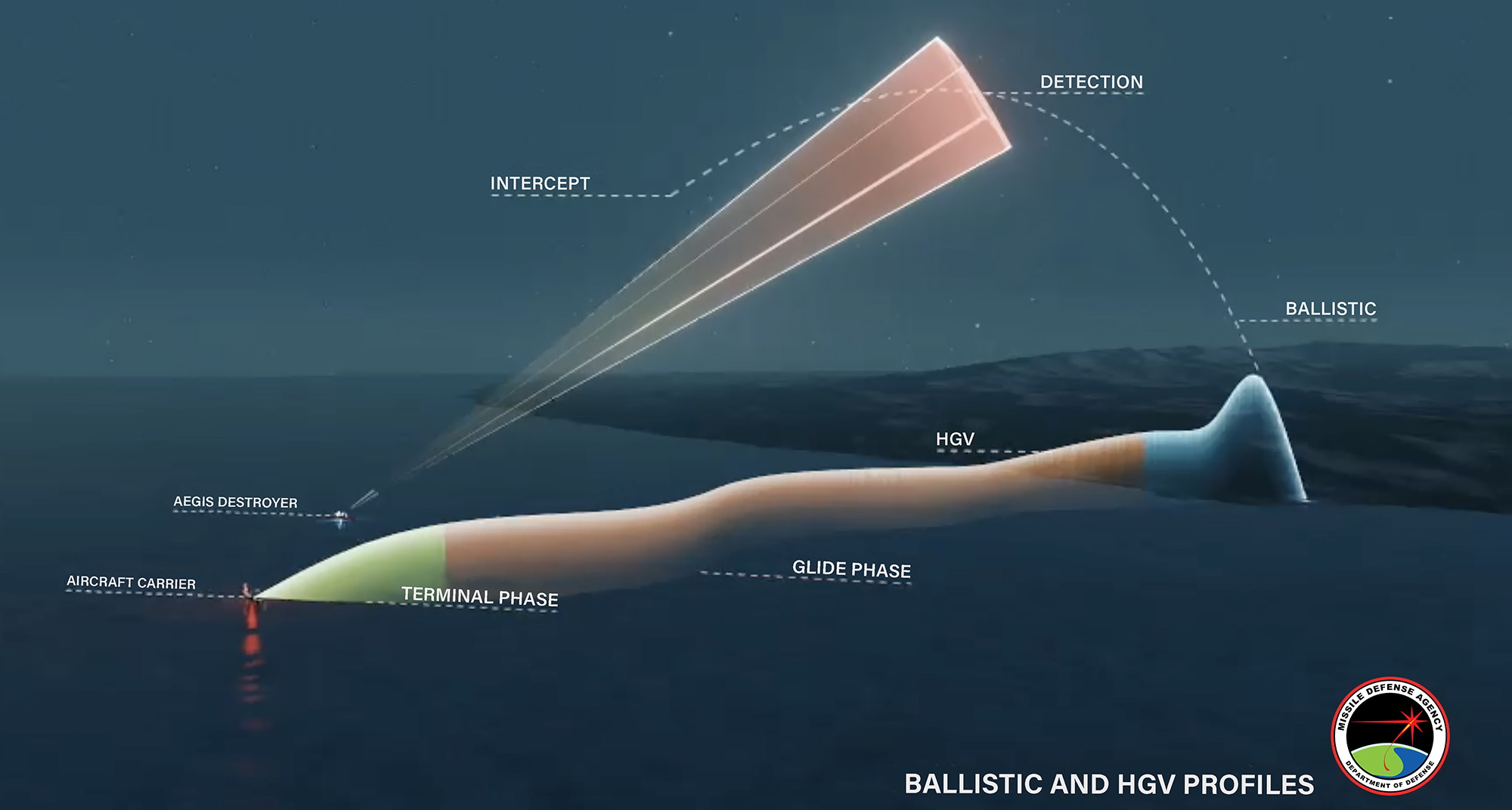
Details regarding Project Maverick were revealed in budget documents issued last month. The project is designed to help the Pentagon establish some form of defense against hypersonic weapons in the coming years, bridging the gap before the more advanced Glide Phase Interceptor (GPI) system, which is not anticipated to be delivered until 2031.
According to the budget documents, the 2027 test will involve a hypersonic glide vehicle flying “up the East Coast” of the United States. During this critical event, the MDA plans to monitor and track the vehicle using “multi-phenomenology” elevated sensor data. This sophisticated approach likely involves a combination of air and space-based platforms equipped with advanced sensors capable of detecting and monitoring various physical characteristics of the high-speed target.
Following data collection, a tactical battle management system will be tasked with processing and fusing this diverse sensor information. This integration is designed to enable an “engage on remote” capability, a crucial aspect of modern missile defense. Engage on remote refers to the ability to guide a weapon to its target using targeting data derived from an external sensor, rather than relying solely on sensors physically co-located with the shooter or the weapon itself. This capability is vital for intercepting fast-moving, elusive targets like hypersonic missiles across vast distances.
While the budget documents do not explicitly state whether Project Maverick will involve a kinetic kill—meaning a physical interception and destruction of the hypersonic vehicle—or precisely which systems will be used, Lieutenant General Heath Collins, Director of the MDA, offered clarification. In his written testimony to the House Armed Armed Services Committee last month, General Collins stated that the effort would “demonstrate capabilities across the kill chain.” This suggests a comprehensive evaluation of the entire sequence of defensive actions, from detection and tracking to targeting and potential engagement. “Successfully demonstrated capabilities would supplement current and future defense architecture,” he added, underscoring the project’s strategic importance.
The urgency behind Project Maverick is rooted in the significant advancements made by U.S. adversaries. Hypersonic systems are defined by their ability to travel and maneuver at speeds exceeding Mach 5 (five times the speed of sound). Both China and Russia have developed and publicly demonstrated multiple hypersonic weapons in recent years, which analysts believe could pose a substantial threat to U.S. national security and its allies. The U.S. has been developing its own long-term countermeasure, the Glide Phase Interceptor (GPI), designed to intercept these threats during their glide phase. However, the GPI program’s timeline has shifted multiple times, and even with a recent infusion of cash from the 2025 reconciliation bill, the system is still not expected to be delivered for another half-decade, highlighting the need for interim solutions.
Recognizing this timeline gap, General Collins stated in 2024 that the MDA was working to “think creatively and bring capability sooner” to defend against the hypersonic threat. He indicated that such immediate capabilities would likely not involve entirely new weapons but rather the repurposing of existing systems. This strategy appears to be feeding into a new broader initiative named “Low-Cost Defeat,” of which Project Maverick is a significant component. Another key part of this initiative is the “Low-Cost Interceptor” (LCI).
The LCI program is currently in a rapid design, test, and demonstration phase. The MDA’s objective is to confirm by 2027 that an interceptor can be built in high numbers at a significantly reduced cost, followed by a prototype test in 2028. For fiscal year 2027, the MDA is requesting a total of $460 million to pursue the LCI program, Project Maverick, and other related advanced research efforts. This funding underscores a strategic shift towards not only developing advanced defensive technologies but also ensuring their affordability and mass production capability.
These focused initiatives are integral to the Pentagon’s larger, ambitious effort to build an advanced missile shield, which has been dubbed “Golden Dome.” This overarching vision entails a layered network of sophisticated sensors, a variety of missile interceptors, and robust command-and-control systems. The projected cost for the entire Golden Dome architecture is estimated at $185 billion, representing a substantial long-term investment in national defense.
The department’s fiscal year 2027 budget request includes $17.9 billion specifically allocated for Golden Dome. While the budget documents do not specify individual funding for every system within the program, they do indicate that these funds will be used to accelerate the development of critical space-based sensors, such as the Hypersonic and Ballistic Tracking Space Sensor (HBTSS). Furthermore, funds are earmarked for developing a proliferated constellation of space-based interceptors and for conducting “rigorous, realistic testing and evaluation of all system components.” The MDA serves as the engineering, integration, and test lead for the entire Golden Dome architecture, ensuring that the various components work seamlessly together.
The goals of Project Maverick are closely intertwined with those of Golden Dome. General Michael Guetlein, Director of Golden Dome, has emphasized the urgency, stating that his program aims to conduct a missile interceptor demonstration by next summer, further highlighting the rapid pace of these defense initiatives.
The cost and availability of interceptors—whether engaging targets from the ground or in space—have become a significant point of interest and concern for U.S. lawmakers. During an April 15 hearing involving General Collins, General Guetlein, and other Pentagon officials, Representative Don Bacon (R-Neb.) highlighted the issue of depleted stocks of ground-based interceptors, citing recent operational demands such as “Operation Epic Fury” in Iran. He also noted that the Pentagon’s fiscal year 2027 budget request includes “tens of billions” to increase interceptor production, signaling a major push to replenish and expand the nation’s defensive arsenal.
In his written testimony, General Collins directly addressed these concerns, stating that one of the primary goals of the Low-Cost Interceptor (LCI) program is to “restore magazine depth.” This refers to the capacity to maintain a sufficient inventory of interceptors for sustained defensive operations. Additionally, he emphasized the program’s aim to lower the “cost-per-kill” by funding the development of a “high-volume, affordable interceptor.” This strategy reflects a broader understanding within the Pentagon that effective missile defense must not only be technologically capable but also economically sustainable in the long term.
Why This Matters
- National Security Imperative:The emergence of hypersonic weapons, particularly from strategic rivals like China and Russia, represents a fundamental shift in global military capabilities. These weapons, with their unparalleled speed and maneuverability, challenge existing missile defense systems and could potentially erode the strategic deterrent capabilities of the United States. Project Maverick and the broader Low-Cost Defeat initiative are direct and urgent responses to this evolving threat, critical for protecting U.S. national interests, assets, and allies.
- Accelerating Technological Arms Race:U.S. efforts in hypersonic defense underscore an accelerating global arms race in advanced military technologies. This competition involves not only the development of new interceptors but also sophisticated tracking, sensor, and command-and-control systems, pushing the boundaries of aerospace engineering, artificial intelligence, and data processing. The outcomes of this technological race will have profound, long-term implications for global power dynamics and future military doctrines.
- Impact on Strategic Stability:The ability—or inability—to effectively defend against hypersonic missiles directly influences strategic stability. If one nation were to gain a decisive advantage, it could alter the calculus of military action, potentially increasing the risk of miscalculation, conventional conflict, or even nuclear escalation. Initiatives like Golden Dome seek to maintain a balance of power by ensuring robust defensive capabilities, thereby contributing to global security.
- Significant Economic Investment:The substantial financial commitment—hundreds of millions for immediate projects like Project Maverick and billions for the overarching Golden Dome missile shield—highlights the enormous economic resources required to maintain technological superiority and national defense in the 21st century. These expenditures will continue to be a major component of national budgets, potentially impacting other domestic spending priorities. The focus on “low-cost” interceptors also represents a strategic effort to make long-term defense sustainable, preventing a scenario where defensive costs become prohibitive.
- Strengthening Alliance Security:The credibility of U.S. missile defense capabilities has direct implications for its alliances worldwide. A robust U.S. defense umbrella provides critical reassurance to allies, particularly those in regions facing immediate threats, such as the Indo-Pacific and Eastern Europe. These advancements reinforce collective security and deterrence.
- Shaping the Future of Warfare:The innovations spurred by the development and defense against hypersonic weapons are poised to significantly shape the future of warfare. The emphasis on distributed, multi-phenomenology sensors, rapid data fusion, and “engage on remote” capabilities points towards a more interconnected, automated, and rapidly responsive battlefield. These developments will influence military doctrine, operational strategies, and the very nature of conflict for decades to come.