Close Menu
Newstech24.com
  • Home
  • News
  • Technology
  • Economy & Business
  • Sports News
What's Hot

Houston, We Have an Outlook Glitch: NASA’s Artemis II Reboot

17/04/2026

Premier League Dream: EFL Highlights, Goals & Shock Results – Coventry, Derby, Middlesbrough, Millwall Battle for Promotion!

17/04/2026

The ‘Big Balls’ of Viral Fraud: Edward Coristine’s New Role Revealed

17/04/2026
Facebook X (Twitter) Instagram
Friday, April 17
Facebook X (Twitter) Instagram
Newstech24.com
  • Home
  • News
  • Technology
  • Economy & Business
  • Sports News
Newstech24.com
Home - Technology - Google AI: Turning Yesterday’s News into Tomorrow’s Flood Warnings
Technology

Google AI: Turning Yesterday’s News into Tomorrow’s Flood Warnings

By Admin12/03/2026No Comments3 Mins Read
Facebook Twitter Pinterest LinkedIn Tumblr Email
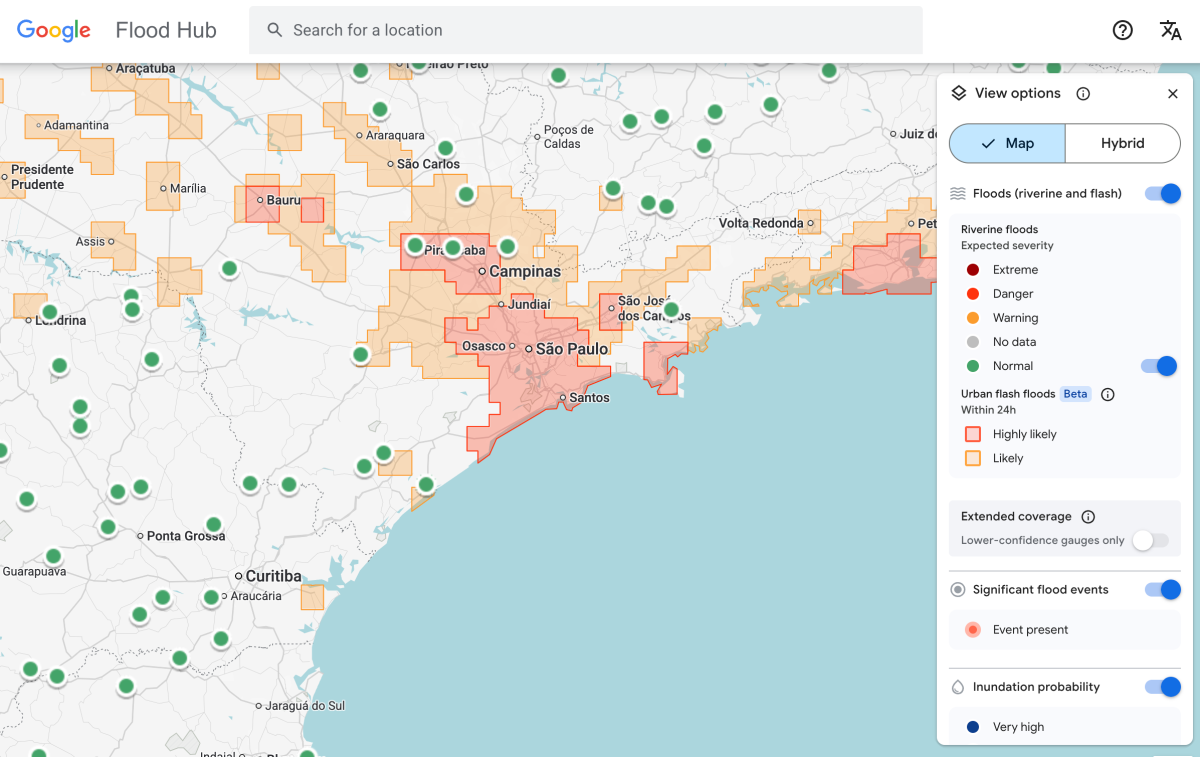
Google is using old news reports and AI to predict flash floods
Share
Facebook Twitter LinkedIn Pinterest Email

Sudden inundations rank among the most lethal meteorological occurrences globally, claiming the lives of over 5,000 individuals each year. They are also notoriously challenging to anticipate. Yet, Google believes it has resolved this issue through an unexpected avenue — by examining news reports.

While a substantial amount of atmospheric data has been gathered by humans, flash floods are too transient and localized to be comprehensively measured, unlike how temperatures or even river flows are continuously monitored. This informational void signifies that deep learning models, which are increasingly adept at predicting weather, cannot forecast these swift floods.

To tackle this predicament, Google’s researchers leveraged Gemini — Google’s large language model — to sift through 5 million news articles worldwide, isolating accounts of 2.6 million distinct flood events. These reports were then transformed into a geo-tagged chronological data set christened “Groundsource.” According to Gila Loike, a product manager for Google Research, this marks the first instance the company has deployed language models for such an undertaking. The findings and the data set were publicly released on Thursday morning.

With Groundsource serving as an empirical foundation, the investigators trained a model built on a Long Short-Term Memory (LSTM) neural network. This model was designed to absorb global weather outlooks and compute the likelihood of flash floods occurring in a specified region.

Google’s predictive model for sudden floods is now underscoring risks for metropolitan areas in 150 nations via the company’s Flood Hub platform. It is also disseminating its information to emergency response organizations across the globe. António José Beleza, an official for emergency operations at the Southern African Development Community, who piloted the forecasting model with Google, stated that it assisted his entity in reacting to inundations with greater alacrity.

Nonetheless, the model still possesses limitations. For instance, it operates at a relatively coarse resolution, pinpointing hazards within 20-square-kilometer zones. Furthermore, it is not as precise as the flood alert mechanism of the US National Weather Service, partially because Google’s model fails to integrate localized radar data, which facilitates instantaneous monitoring of rainfall.

A core objective, however, is that the initiative was conceived for deployment in locales where local administrations lack the financial means to fund costly meteorological sensing facilities or possess inadequate historical weather data.

Techcrunch event

San Francisco, CA
|
October 13-15, 2026

“Because we’re amassing millions of reports, the Groundsource data set actually contributes to redressing geographical imbalances,” Juliet Rothenberg, a program manager on Google’s Resilience team, informed journalists earlier this week. “It permits us to infer for other locales where less data is available.”

Rothenberg expressed the team’s aspiration that leveraging large language models to construct measurable data collections from textual, descriptive origins could be utilized in endeavors to compile data sets about other transient yet crucial-to-predict occurrences, like periods of intense heat and landslides.

Marshall Moutenot, the Chief Executive Officer of Upstream Tech, a firm that employs analogous deep learning systems to predict water currents in rivers for clients such as hydroelectric power firms, noted that Google’s input constitutes a component of an expanding initiative to compile information for meteorological prediction models founded on deep learning. Moutenot was a co-founder of dynamical.org, an organization maintaining an archive of weather data prepared for machine learning applications for scholars and nascent businesses.

“A dearth of data represents a formidable hurdle within geophysics,” Moutenot commented. “Concurrently, an abundance of terrestrial data exists, yet when empirical validation is sought, insufficiency prevails. This constituted an exceptionally inventive method for acquiring such information.”


{content}

Source: {feed_title}

Like this:

Like Loading...

Related

flash floods Google News predict Reports
Share. Facebook Twitter Pinterest LinkedIn Tumblr Email
Admin
  • Website

Related Posts

Houston, We Have an Outlook Glitch: NASA’s Artemis II Reboot

17/04/2026

Premier League Dream: EFL Highlights, Goals & Shock Results – Coventry, Derby, Middlesbrough, Millwall Battle for Promotion!

17/04/2026

The ‘Big Balls’ of Viral Fraud: Edward Coristine’s New Role Revealed

17/04/2026
Leave A Reply Cancel Reply

Don't Miss
Technology

Houston, We Have an Outlook Glitch: NASA’s Artemis II Reboot

By Admin17/04/20260

Even in the vast silence of space, some problems transcend the cosmos. While orbiting Earth…

Like this:

Like Loading...

Premier League Dream: EFL Highlights, Goals & Shock Results – Coventry, Derby, Middlesbrough, Millwall Battle for Promotion!

17/04/2026

The ‘Big Balls’ of Viral Fraud: Edward Coristine’s New Role Revealed

17/04/2026

The Conspiracy Gravity Well: Why We Can’t Look Away

17/04/2026

NCAA Women’s Tournament: Auriemma Declares Two-Site Format a ‘No-Brainer’

17/04/2026

LeBron James’ Memphis Remark: Why NBA Coaches Are Pushing Back So Hard

17/04/2026

NHL Playoff Standings: Saturday’s High-Stakes Showdown & Essential Game Guide

17/04/2026

Unleashing Lightning: Pentagon’s 2027 Budget Targets 38 F-35s for Air Force

17/04/2026

Haaland’s Thunderous Treble Forges FA Cup History

17/04/2026

Mallorca vs. Real Madrid: La Liga’s Island Showdown

17/04/2026
Advertisement
About Us
About Us

NewsTech24 is your premier digital news destination, delivering breaking updates, in-depth analysis, and real-time coverage across sports, technology, global economics, and the Arab world. We pride ourselves on accuracy, speed, and unbiased reporting, keeping you informed 24/7. Whether it’s the latest tech innovations, market trends, sports highlights, or key developments in the Middle East—NewsTech24 bridges the gap between news and insight.

Company
  • Home
  • About Us
  • Contact Us
  • Privacy Policy
  • Disclaimer
  • Terms Of Use
Latest Posts

Houston, We Have an Outlook Glitch: NASA’s Artemis II Reboot

17/04/2026

Premier League Dream: EFL Highlights, Goals & Shock Results – Coventry, Derby, Middlesbrough, Millwall Battle for Promotion!

17/04/2026

The ‘Big Balls’ of Viral Fraud: Edward Coristine’s New Role Revealed

17/04/2026

The Conspiracy Gravity Well: Why We Can’t Look Away

17/04/2026

NCAA Women’s Tournament: Auriemma Declares Two-Site Format a ‘No-Brainer’

17/04/2026
Newstech24.com
Facebook X (Twitter) Tumblr Threads RSS
  • Home
  • News
  • Technology
  • Economy & Business
  • Sports News
© 2026

Type above and press Enter to search. Press Esc to cancel.

Powered by
►
Necessary cookies enable essential site features like secure log-ins and consent preference adjustments. They do not store personal data.
None
►
Functional cookies support features like content sharing on social media, collecting feedback, and enabling third-party tools.
None
►
Analytical cookies track visitor interactions, providing insights on metrics like visitor count, bounce rate, and traffic sources.
None
►
Advertisement cookies deliver personalized ads based on your previous visits and analyze the effectiveness of ad campaigns.
None
►
Unclassified cookies are cookies that we are in the process of classifying, together with the providers of individual cookies.
None
Powered by
%d