
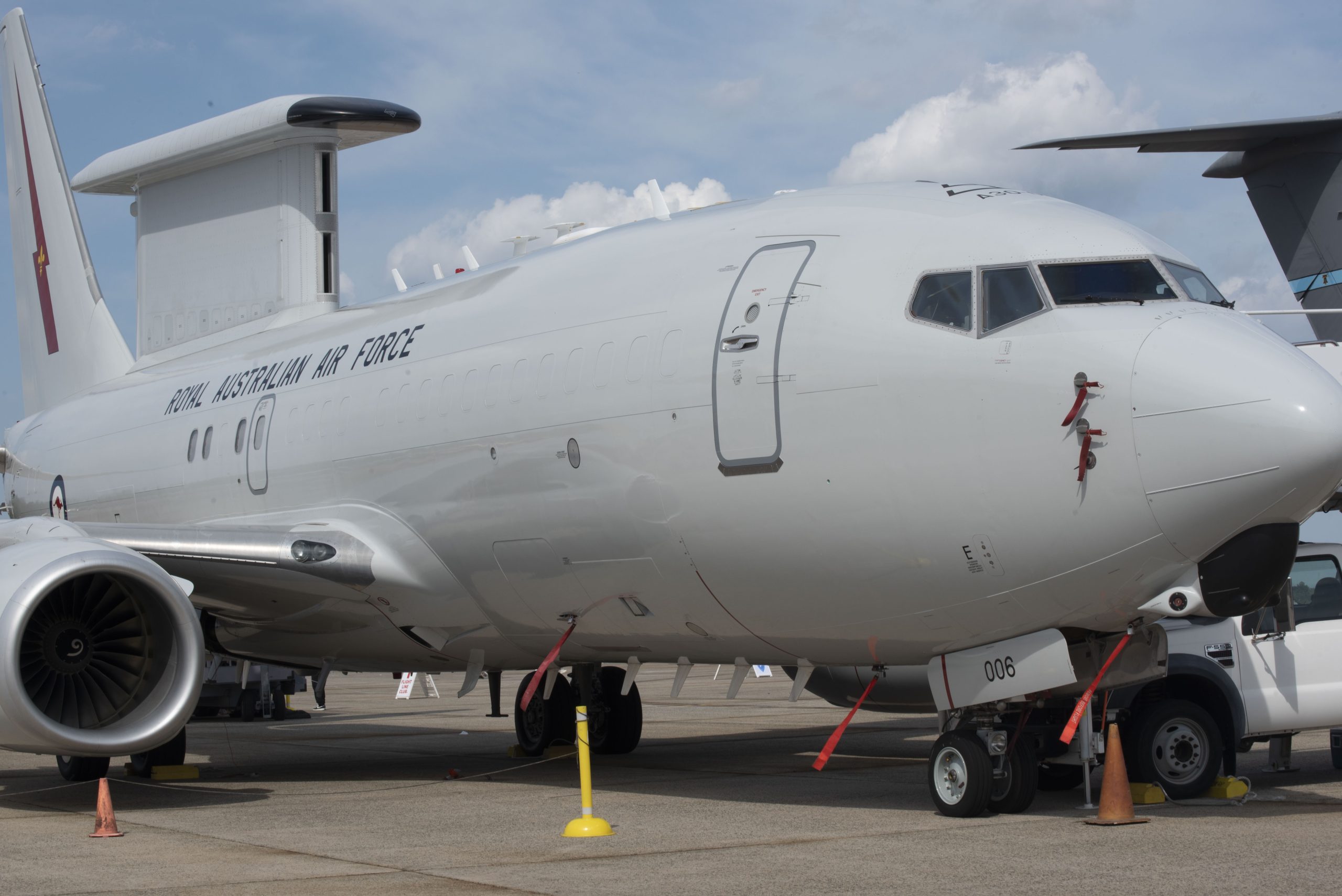
The U.S. Air Force is seeking a significant budget amendment totaling $1.5 billion to reinstate funding for the E-7A Wedgetail program in fiscal year 2027, with continued funding planned for 2028 and beyond. This move marks a reversal from previous budgetary proposals that had sought to eliminate the program.
Air Force Secretary Troy Meink confirmed the development to lawmakers on May 20, explaining that the request is currently in the approval process. The proposed amendment aims to secure funding for the initial five production aircraft starting in fiscal year 2028, in addition to two rapid prototypes already part of the acquisition plan. Meink stated, “Our plan is to submit a budget adjustment to fund the FY 27 and, as we do the [fiscal 2028 budget] to lay in the production of the seven aircraft.”
The E-7A Wedgetail, manufactured by Boeing, is an advanced airborne battle management aircraft derived from the Boeing 737 airliner. Its primary role is to replace the Air Force’s aging fleet of E-3 Sentry Airborne Warning and Control System (AWACS) planes. The Royal Australian Air Force already operates several Wedgetail jets, and the U.S. Air Force initially envisioned acquiring a fleet of up to 26 E-7s.
The E-3 Sentry fleet, built on the 1960s-era Boeing 707 airframe, has been operational since the 1970s. The current fleet has dwindled to just 15 aircraft, with Air Force officials consistently highlighting the increasing difficulty of maintenance and the inadequacy of their sensor capabilities against contemporary threats. The urgency for a replacement was underscored in April when an AWACS jet was destroyed during an Iranian attack on Prince Sultan Air Base in Saudi Arabia, further reducing the operational fleet.
The decision to restore funding follows a period of uncertainty for the Wedgetail program. The Pentagon had initially attempted to cut E-7 funding in the proposed 2026 budget, a decision that was subsequently overturned by Congress. Similarly, the original 2027 budget plan also omitted funding for the program, before Defense Secretary Pete Hegseth announced a reversal on May 12, confirming the program would be funded.
Secretary Meink attributed the earlier plans to cut the Wedgetail program to severe budget constraints. He explained that with a total defense budget of $890 billion, the Air Force “could not afford” the E-7, necessitating cuts to programs it preferred to retain. However, with the Trump administration now seeking a record $1.5 trillion defense budget package for 2027, Meink noted a newfound “flexibility” that allows for the reinstatement of such crucial programs. He added that while the Air Force had explored alternative solutions, such as space-based assets, to fulfill the mission without the E-7, having the Wedgetail “helps make that problem easier.”
Air Force Chief of Staff Gen. Kenneth S. Wilsbach echoed Meink’s sentiments, emphasizing the E-7’s superior capability. Wilsbach stated that the Wedgetail offers “the highest capability to be flexible and get the air battle manager in the right space, at the right time, to manage that battle.” The Air Force’s long-term strategy involves an integrated architecture combining space-based and airborne moving target indication assets, with Meink urging lawmakers to support these efforts. He also indicated that the E-7 is designed to be a “multi-use platform,” potentially contributing to future initiatives such as the Pentagon’s “Golden Dome for America” missile defense shield.
The proposed budget amendment and the procurement of the E-7 appear to enjoy significant bipartisan support in Congress. House Appropriations Committee Chairman Rep. Tom Cole (R-Okla.), whose district includes Tinker Air Force Base—a key hub for the E-3 fleet—has been a vocal advocate for the program. In a May 14 interview, Cole affirmed, “We’re going to be supportive on the Appropriations Committee and try to help the Air Force and the military in general get to where it needs to be.”
Despite the renewed commitment, the ultimate number of E-7s the Air Force intends to acquire remains uncertain, potentially falling short of the initial plan for 26 aircraft. Rep. Cole acknowledged the protracted nature of the acquisition, stating, “It’s going to take a while to get the number of E-7s that we need and the capability that we need, and that’s multiple budget cycles.”
Challenges persist beyond just program funding. The proposed $1.5 trillion defense budget itself is expected to face considerable scrutiny and potential headwinds in Congress. Rep. Cole expressed skepticism that a defense budget would be signed into law before the end of the fiscal year, particularly as Congress approaches midterm elections. This perennial issue of continuing resolutions, where agencies operate on previous year’s funding levels for months, complicates the Pentagon’s ability to engage in effective long-term planning. “All that complicates productive long-term planning from the Pentagon’s standpoint,” Cole remarked. “It’s not their fault. It’s just the reality. … They’ve got to think through, ‘How can I acquire the platforms I need, how can I sustain that platform over decades when I’ve got a very volatile political environment right now?’”
Cole concluded by reiterating the critical importance of airborne battle management, citing the recent air campaign against Iran as a “good reminder” of its utility, even with the aging E-3s. He emphasized that the E-7 represents a capability the U.S. cannot afford to lose, particularly in the context of confronting near-peer adversaries. “There’s a lot at stake here,” Cole stated. “There’s a capability here we don’t want to lose that we think is absolutely critical to being successful, particularly against a near-peer power, so I think all those things came together.”
Why This Matters
The U.S. Air Force’s renewed push to fund the E-7A Wedgetail program carries significant implications for national security, military readiness, technological advancement, and defense spending. The decision to invest $1.5 billion in this airborne battle management system underscores a critical pivot in strategic defense planning and resource allocation.
National Security and Military Readiness:The E-7A Wedgetail is slated to replace the E-3 Sentry AWACS fleet, which has been in service since the 1970s and is increasingly obsolete against modern threats. The continued reliance on an aging platform poses a tangible risk to U.S. air superiority and its ability to manage complex air battles. The recent destruction of an E-3 jet in a hostile attack highlights the vulnerability and operational limitations of the current fleet. The Wedgetail, with its advanced sensors and battle management capabilities, is vital for maintaining a decisive edge in intelligence, surveillance, reconnaissance, and command and control, especially against technologically sophisticated adversaries. This directly impacts the safety of U.S. forces and the effectiveness of military operations globally.
Defense Spending and Budgetary Politics:The shift from cutting the E-7 program to reinstating its funding reflects broader dynamics in U.S. defense budgeting. The initial decision to cut was attributed to an $890 billion budget ceiling, while the reversal coincides with a proposed $1.5 trillion defense budget. This illustrates how overall budget levels significantly influence which critical programs get funded. The journey of the E-7 funding—initially zeroed out by the Pentagon, then reversed by Congress, and now reinstated by the Defense Secretary—also showcases the complex interplay between the executive branch and legislative oversight in defense appropriations. The ultimate approval of the $1.5 trillion defense budget itself faces political headwinds, potentially leading to continuing resolutions that can hamper long-term military procurement and planning.
Technological Advancement and Future Warfare:The E-7A represents a modernization of airborne battle management, transitioning from a decades-old platform to one based on a modern airliner. Its multi-use potential, including a possible role in missile defense, signifies a move towards more adaptable and integrated defense systems. The Air Force’s long-term vision of combining space-based and airborne assets points to an evolving doctrine of warfare where information superiority and seamless command and control across multiple domains are paramount. Investing in platforms like the E-7 is crucial for developing and integrating the technologies required for future conflicts.
Industrial Base and Economic Impact:As a Boeing-built aircraft, the E-7A program supports the U.S. aerospace and defense industrial base, sustaining high-skilled jobs and fostering technological innovation. Delays or cancellations of such programs can have ripple effects on manufacturers, suppliers, and the broader economy. Consistent funding signals stability and confidence in the defense sector, encouraging further investment and development.
Geopolitical Implications:A robust U.S. airborne command and control capability is a cornerstone of its global military presence and its ability to support allies. The E-7A’s capabilities can enhance interoperability with partners like Australia, who already operate the Wedgetail. Ensuring the U.S. maintains its surveillance and battle management edge is critical for projecting power, deterring aggression, and responding effectively to crises in volatile regions.
In essence, the decision to fund the E-7A Wedgetail is not merely about acquiring new aircraft; it is about sustaining U.S. military advantage, adapting to evolving threats, navigating complex budgetary landscapes, and shaping the future of defense capabilities.