
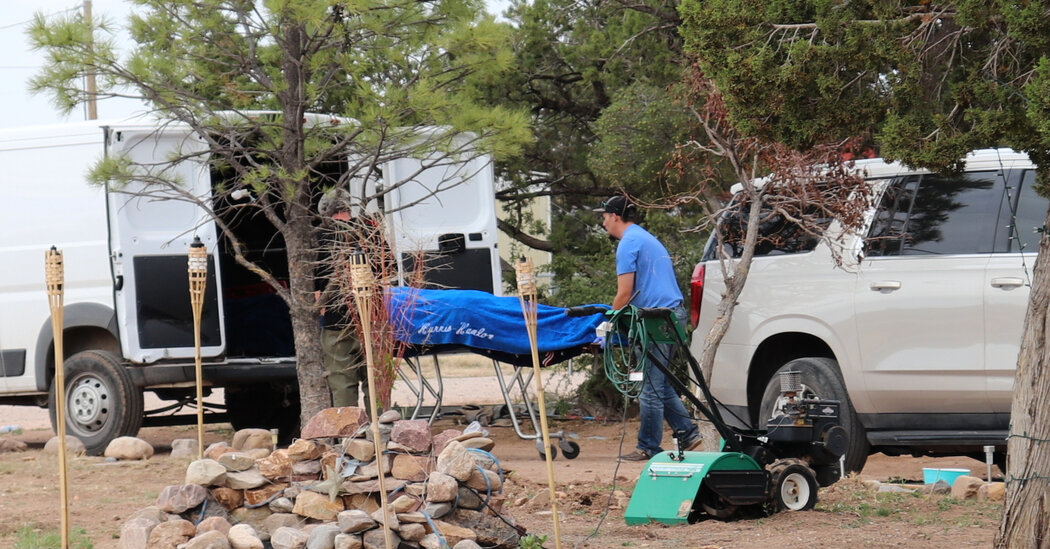
Fatal Incident in New Mexico Prompts Multi-Agency Hazardous Materials Response, Three Dead
Mountainair, New Mexico – A tragic incident in a small New Mexico town has resulted in the deaths of three individuals and the hospitalization of more than a dozen emergency personnel following suspected exposure to an unknown hazardous substance. The event, which unfolded on Wednesday in Mountainair, approximately 40 miles southeast of Albuquerque, prompted a significant multi-agency response involving state, county, and federal authorities, including a specialized hazardous materials team.
New Mexico State Police reported that officers, accompanied by personnel from the Torrance County Sheriff’s Office, initially responded to a residential property in Mountainair around 11:00 a.m. The call originated as a report of a possible drug overdose. Upon arrival, emergency responders discovered four individuals inside the home who were unresponsive. Authorities have since confirmed that three of these individuals have died. Mayor Peter Nieto of Mountainair, a town with a population of just over 1,000 residents, stated on social media that two fatalities were pronounced at the scene, with a third person succumbing later.
The situation escalated rapidly as emergency officials began to experience adverse effects. In total, 18 emergency responders, including law enforcement officers and paramedics, were exposed to the unidentified substance while operating at the scene. These individuals subsequently began to exhibit symptoms consistent with exposure, including nausea and dizziness. The severity of the exposure varied among the personnel, with state police indicating that two officials were initially in serious condition.
All affected emergency officials, along with the fourth individual found unresponsive inside the home, were promptly transported to the University of New Mexico Hospital in Albuquerque. At the hospital, they were placed in quarantine and underwent monitoring as medical staff assessed their conditions and initiated decontamination protocols. The University of New Mexico Hospital later provided an update, confirming that it had assessed and decontaminated a total of 23 patients in connection with the incident. The majority of these individuals, who were asymptomatic, were subsequently discharged. However, three patients who continued to display symptoms such as headaches, nausea, and vomiting remained under observation and monitoring at the facility.
The nature of the substance remains the primary focus of an intensive investigation. Authorities are working diligently to identify the chemical agent responsible for both the fatalities and the symptoms experienced by the first responders. The incident triggered a large-scale emergency and law enforcement deployment, drawing resources from multiple agencies. The Federal Bureau of Investigation’s (F.B.I.) Albuquerque office became involved, lending its expertise and resources to the complex scene. Additionally, hazardous materials (HAZMAT) teams from Albuquerque Fire Rescue were instrumental in the on-site operations, assisting with the collection of samples, preliminary substance identification efforts, and comprehensive decontamination procedures to ensure the safety of the area.
Investigators from the New Mexico State Police have indicated that current evidence suggests the unknown substance was likely transmitted through direct contact, rather than being airborne. This assessment has contributed to authorities’ confidence in stating that there is no ongoing threat to the broader public. While the immediate danger to the community has been mitigated, the painstaking process of forensic analysis and investigation is underway to determine the exact composition of the substance and the circumstances leading to this tragic event.
This incident serves as a stark reminder of the unpredictable dangers faced by emergency service personnel and highlights the critical importance of specialized training and equipment for managing hazardous materials. The ongoing investigation will not only seek to provide answers for the victims and their families but also to understand the broader implications for public safety protocols and emergency response strategies in dealing with unknown chemical threats.
***
Why This Matters
The tragic events in Mountainair, New Mexico, underscore several critical issues with significant implications beyond this small community. Firstly, it highlights the inherent and often unseen dangers faced by first responders. Police officers, firefighters, and paramedics routinely put themselves in harm’s way, but incidents involving unknown hazardous substances present a unique and elevated level of risk. Without immediate identification of a chemical agent, responders must operate under extreme caution, relying on generalized hazardous materials protocols, which can still expose them to unforeseen threats. The hospitalization of numerous emergency personnel serves as a powerful testament to their sacrifice and the critical need for advanced training, protective equipment, and robust safety procedures.
Secondly, this incident brings into sharp focus the vital role of inter-agency cooperation and specialized hazardous materials (HAZMAT) capabilities. A situation like this requires a rapid, coordinated response from multiple layers of government and expertise, ranging from local law enforcement and emergency medical services to state police, federal agencies like the FBI, and dedicated HAZMAT units. The swift activation of such a diverse team, including decontamination efforts and sample collection, is crucial for containment, investigation, and ensuring public safety. It demonstrates the importance of ongoing investment in these specialized units and regular inter-agency drills to maintain readiness for complex and dangerous scenarios.
Thirdly, the incident raises important questions about public health preparedness and hospital protocols for mass exposure events. The University of New Mexico Hospital’s role in assessing, decontaminating, and monitoring 23 patients demonstrates the significant logistical and medical challenges involved. Hospitals must have robust plans in place to handle patients exposed to unknown agents, which includes isolation capabilities, specialized decontamination showers, and the ability to provide symptomatic treatment without full knowledge of the causative substance. This incident serves as a real-world test case for these protocols, emphasizing the need for ongoing readiness in healthcare systems to protect both patients and medical staff.
Finally, while the exact nature of the substance is still under investigation, the event serves as a stark reminder of the potential for deadly chemicals or illicit drugs to pose an immediate and severe threat in residential settings. Whether an industrial chemical, a home-made toxin, or an extremely potent synthetic opioid, the presence of such materials can turn an ordinary emergency call into a mass casualty incident. The ongoing investigation will be critical not only for forensic purposes but also for informing public awareness campaigns, regulatory efforts, and preventative measures against the dangers of unknown or illicit substances in communities, regardless of their size or location. This is a global concern, as communities worldwide grapple with similar challenges in identifying and mitigating hazards from novel or potent chemical compounds.