
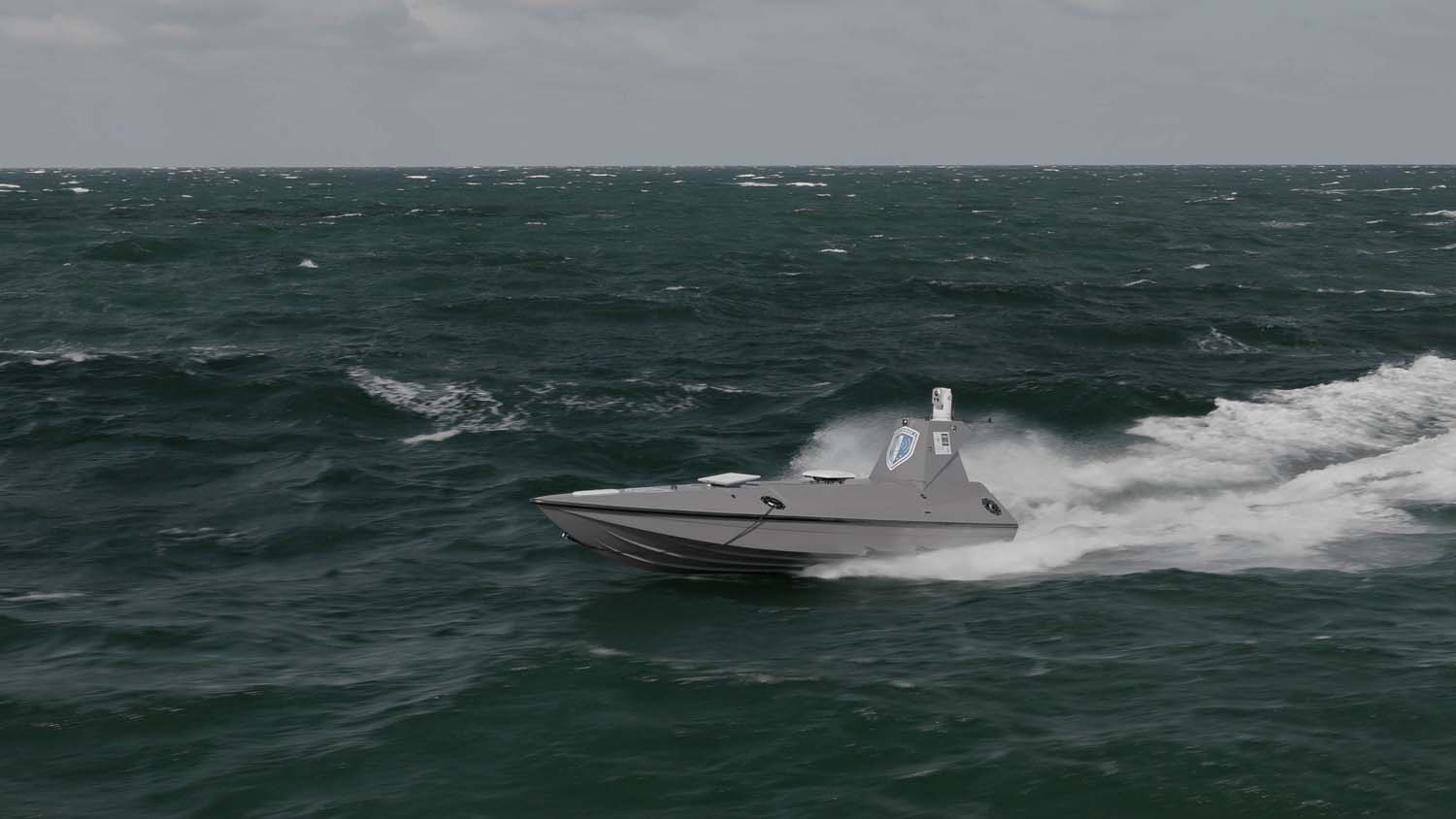
Royal Navy Spearheads Uncrewed Warfare with Rapid Deployment of Kraken USVs
Portsmouth Naval Base has become the initial operational hub for twenty Kraken K3 Scout uncrewed surface vessels (USVs), marking a significant milestone in the Royal Navy’s adoption of autonomous maritime technology. These vessels, delivered and now in service, represent a tangible outcome of Project Beehive, a program designed to rapidly integrate and test cutting-edge uncrewed capabilities.
Captain Adam Ballard, the Royal Navy officer overseeing Project Beehive, highlighted the speed of this acquisition. “We’ve gone from an RFI [Request for Information] out to industry, through a tender process, to 20 boats in Portsmouth Dockyard in about five or six months,” he stated, addressing skepticism about the pace of military procurement. This rapid turnaround underscores a deliberate shift in the Royal Navy’s approach to acquiring new capabilities.
Project Beehive, an investment of £12.3 million (approximately $15.5 million USD), is primarily focused on equipping the Coastal Forces Squadron and 47 Commando Royal Marines with these USVs. The program is explicitly framed as a proving ground, intended to experiment with new concepts and hardware in real-world conditions. Captain Ballard acknowledged the inherent uncertainty in such pioneering work, stating, “Let’s have some humility and go, I don’t know,” when discussing the ultimate direction of these trials.
The Kraken K3 Scout USVs are compact by conventional naval standards, measuring 8.4 meters (27.5 feet) in length and displacing less than 2,500 kilograms (5,500 pounds). A key feature is their modular payload bay, capable of carrying up to 600 kilograms (1,320 pounds) of equipment. This modularity allows for rapid reconfiguration, transforming a vessel from an intelligence, surveillance, and reconnaissance (ISR) platform into an electronic warfare or surface warfare asset in approximately ninety minutes. Captain Ballard likened its versatility to a “Toyota Hilux of the seas,” emphasizing the broad range of applications possible with its payload capacity.
The flexibility of the Kraken USVs extends beyond their modular payloads. The individual modules can be constructed and transported globally via air, then integrated with USVs already deployed in theater. Kraken is also developing an air-dispatch option, which would enable payload modules to be parachuted from an A400 transport aircraft. Recent enhancements include extended-range fuel tanks, pushing their operational endurance beyond the standard 650 nautical miles (approximately 1,200 kilometers). Captain Ballard noted that this range is comparable to “driving from Portsmouth to Estonia on one tank of fuel,” highlighting its strategic significance.
Further integration efforts are underway, with launch and recovery systems in final trials to enable deployment from Type 26 and Type 31 frigates. This capability would allow USVs to establish a force protection screen in constricted waterways, countering asymmetric threats at a fraction of the cost of traditional crewed platforms. The vessels are designed to operate via satellite communications and mesh radios, and will be directly connectable to the Commando Forces Network, providing integrated support for Royal Marines raiding parties. “This is not just a pet toy project, this is a proper part of the Navy,” Captain Ballard affirmed, stressing the deep integration into the joint force structure. He drew an analogy to air power, envisioning frigates deploying “loyal wingmen” to form a protective screen around a task group, a concept previously “unheard of in naval warfare.”
The Kraken USVs are equipped with onboard Graphics Processing Units (GPUs), enabling the execution of artificial intelligence (AI) models directly on the platform. Captain Ballard clarified that this focuses on “platform autonomy” rather than lethal autonomous weapon systems. The aim is to offload “dull, dangerous, dirty stuff” to AI, allowing human operators to concentrate on complex decision-making and contextual understanding.
The learning process, Captain Ballard emphasized, is as crucial as the hardware itself. The Royal Navy has already conducted three iterations of USV operator training, formally endorsed by the Maritime Coastguard Agency. A contract for a virtual training environment has been signed, designed for both skills development and mission rehearsal. The transition from traditional ship bridge operations to screen-based remote control presented unforeseen challenges, necessitating significant redesign of ground control station interfaces. “It’s really different sitting in front of a screen looking at a visualization of the sea than it is standing on the bridge that I did for 20 years,” Captain Ballard observed.
Communication reliability at sea has also emerged as a critical hurdle. Despite commercial satellite system promises, real-world performance has revealed gaps, prompting extensive development of “robust reversionary comms plans.” A more fundamental, and entirely unaddressed, question has also arisen: the legal status of uncrewed surface vessels. “There is no legal precedent,” Captain Ballard stated, indicating that the Royal Navy is actively grappling with whether a USV should be classified as a warship under international law.
Regarding lessons from the conflict in Ukraine, Captain Ballard offered a nuanced perspective. He cautioned against direct extrapolation, noting that the “Black Sea is a lake” with vastly different sea states compared to the North Atlantic. He believes small USVs are ideally suited for environments like the Norwegian fjords, the Baltic, North Sea, and English Channel, but acknowledged that larger platforms and traditional crewed assets retain their crucial role in the deep Atlantic. Project Beehive, he clarified, is not the ultimate goal but a deliberate “on-ramp” to a broader transformation. Future funding for remote and autonomous systems will increasingly focus on the digital architecture that interconnects these platforms, forming what he termed a “maritime fighting web.”
The development strategy for adding capabilities to the boats follows a “crawl-walk-run” approach: initially focusing on ISR, then adding sensors, and finally effectors, with each step validated before proceeding. This iterative process is significantly faster than integrating new capabilities onto crewed platforms like a Type 45 destroyer, which can take years and billions of pounds. With generic unmanned hulls, advancements can be made in six to nine-month cycles, allowing for rapid iteration and adaptation.
This expedited pace is also reshaping the Royal Navy’s procurement landscape. Captain Ballard highlighted a commitment to engaging small and medium enterprises (SMEs) on equal footing with large defense primes. Kraken, an SME itself, delivered the twenty vessels in under six months, serving as a proof of concept for both the technology and this procurement philosophy. “We are going to interface with small and medium enterprises as much as we interface with the big primes,” he affirmed.
On the question of whether twenty boats are sufficient, Captain Ballard articulated a strategy rooted in humility and learning. While an argument could be made for acquiring fifty vessels immediately or mixing different types, he dismissed this as “a really foolish thing to do.” He explained that a larger initial purchase would risk locking in unforeseen mistakes and developing payloads for poorly understood problems, thereby sacrificing the very flexibility that makes the program valuable. “I don’t want more yet. I will do, but not yet, because I want to learn,” he stated, anticipating the operation of larger uncrewed platforms before the end of the current calendar year, informed by the initial trials.
Captain Ballard views this project not merely as a side task but through the lens of naval history. He believes the rapid adoption of USVs represents the “vanguard of the next major transition in naval warfare,” drawing a parallel to transformative moments like the advent of the Dreadnought battleship. For the Royal Navy, he concluded, “This is another Dreadnought moment.”
Why This Matters
The Royal Navy’s rapid deployment of Kraken K3 Scout uncrewed surface vessels (USVs) under Project Beehive signifies a pivotal shift in modern naval warfare and defense procurement. This initiative is not merely about acquiring new boats but about fundamentally re-evaluating how naval forces operate, develop, and integrate technology. Here’s why it holds significant importance:
- Accelerated Naval Modernization:The speed with which these USVs were delivered and integrated—within six months—demonstrates a new model for defense acquisition. This “crawl-walk-run” approach allows for faster iteration, learning, and adaptation, a stark contrast to the decades-long development cycles of traditional crewed warships. This rapid pace is critical in an era where technological advantages can be fleeting.
- Redefining Naval Power Projection:USVs offer a cost-effective way to project presence, conduct surveillance, and potentially engage threats without risking human life. Their modularity allows for rapid role changes (ISR, electronic warfare, surface warfare), providing unprecedented flexibility to task groups. The concept of “loyal wingmen” for frigates could significantly extend the reach and protective capabilities of existing fleets, fundamentally altering how naval task forces operate and defend themselves against evolving asymmetric threats.
- Technological Frontier in AI and Autonomy:The integration of onboard AI for “platform autonomy” highlights a move towards human-machine teaming, where AI handles “dull, dangerous, dirty” tasks, freeing human operators for complex decision-making. This push will drive innovation in AI safety, ethics, and operational effectiveness in maritime environments, setting precedents for other nations.
- Addressing New Legal and Ethical Challenges:The Royal Navy’s candid acknowledgment of the lack of legal precedent for USV status (e.g., whether it constitutes a warship) underscores a critical emerging challenge for international maritime law. As more nations deploy autonomous systems, establishing clear legal frameworks for their operation, accountability, and engagement protocols will be paramount to prevent future conflicts and maintain global stability.
- Transforming Defense Procurement:Project Beehive’s emphasis on engaging small and medium enterprises (SMEs) alongside established defense primes marks a significant shift. This inclusive approach fosters innovation, reduces reliance on a few large contractors, and can bring novel solutions to market faster, benefiting the defense industry as a whole.
- Implications for Global Security and Alliances:As a leading naval power, the Royal Navy’s advancements in uncrewed systems will likely influence allied nations and potential adversaries. The development of a “maritime fighting web” of interconnected autonomous assets could reshape naval strategies, intelligence gathering, and force structures globally, intensifying the ongoing race for technological superiority in defense.
- Geopolitical Context:While direct lessons from Ukraine are carefully considered, the utility of smaller USVs in contested littorals like the Baltic, North Sea, and even the English Channel demonstrates their relevance to European security and NATO’s defensive posture. Their limitations in the deep ocean also highlight the continuing need for a balanced fleet of both crewed and uncrewed assets.
In essence, Project Beehive is more than just a procurement program; it is an experimental vanguard that is not only equipping the Royal Navy with advanced tools but also actively shaping the future doctrine, legal frameworks, and industrial partnerships that will define naval power in the 21st century. It represents a “Dreadnought moment” because it signals a fundamental shift in naval capabilities, much like the revolutionary impact of the first all-big-gun battleship over a century ago.