
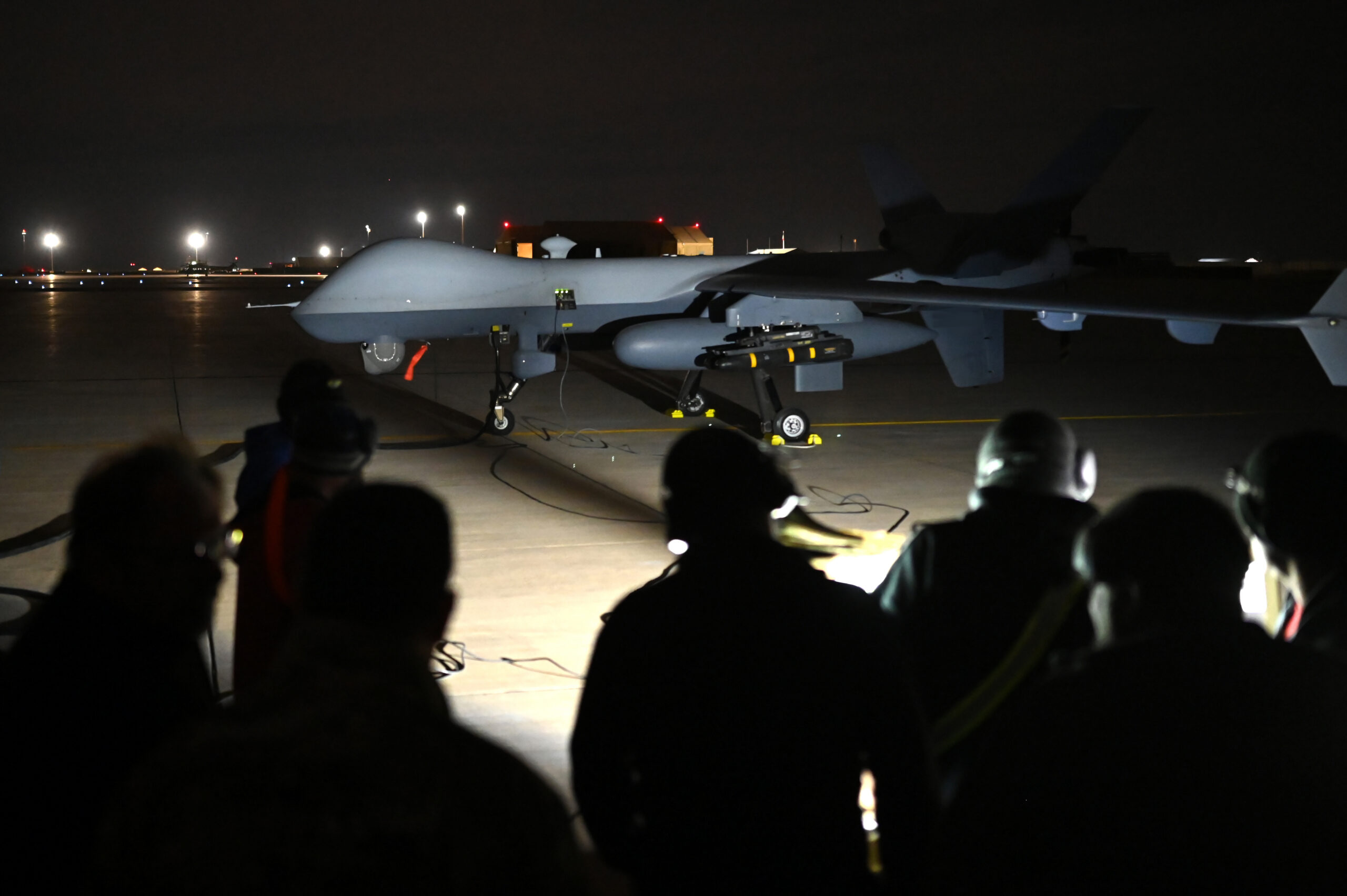
U.S. Air Force MQ-9 Reaper drones have played a central role in recent military operations against Iran, designated “Operation Epic Fury,” according to Chief of Staff Gen. Kenneth S. Wilsbach. Speaking to the House Armed Services Committee on May 20, Gen. Wilsbach identified the unmanned MQ-9 as the “most valuable player” in the conflict, despite the Air Force’s prior considerations to retire the platform in the coming years. This assessment was provided in response to a question from Rep. Mike Rogers (R-Ala.) regarding the Air Force’s strategy for future unmanned and autonomous systems.
Gen. Wilsbach, a career fighter pilot, stated that the Reaper has conducted a significant number of strikes against Iranian targets, though he did not provide a precise figure. The broader U.S. military conducted approximately 13,000 strikes against Iran during a six-week period from late February to early April, before a ceasefire was established. While nearly all types of fighter and bomber aircraft in the Air Force’s inventory—including F-15Es, F-16s, F-22s, F-35s, A-10s, B-52s, B-1s, and B-2s—were deployed, Gen. Wilsbach emphasized that “No other platform is even close to the MQ-9” in terms of strike numbers. He also highlighted the advantage of the MQ-9’s remote operation, which keeps pilots out of direct harm’s way.
The extensive deployment of MQ-9 Reapers has incurred substantial losses. Individuals familiar with the operations reported to Air & Space Forces Magazine that nearly 30 MQ-9 Reapers have been lost during operations against Iran. These losses were attributed to various factors, including Iranian air defenses and strikes against MQ-9s based on the ground in the region, as Iran has targeted U.S. bases. Gen. Wilsbach reiterated the platform’s utility, stating, “It’s an unmanned platform, so we get a lot of utility out of them, and don’t put our folks at risk.”
MQ-9 Reapers continue to be utilized in operations against Iran, particularly around the Strait of Hormuz, where they are enforcing an ongoing U.S. military blockade of Iranian ports. Beyond their strike capabilities, Reapers are equipped with a range of sensors, radars, and cameras, enabling them to collect and transmit data globally to their operators and commanders. While the U.S. military has not provided detailed breakdowns of sorties flown during Operation Epic Fury, Gen. Wilsbach’s remarks suggest the aircraft have frequently operated in high-threat environments. U.S. Central Command has declined to comment on the specific roles Reapers are playing against Iran.
During the intense air campaign, Reapers reportedly maintained approximately a dozen orbits over Iran simultaneously, primarily focusing on striking or providing intelligence for other platforms to hit “dynamic targets.” These targets included mobile missile and drone launchers, airfields, and moving targets. In one instance, MQ-9s were instrumental in protecting a downed F-15E Strike Eagle weapon systems officer by striking Iranian military-aged males who were perceived as a threat and approached within three kilometers of the Airman.
However, the slow-flying Reaper, capable of remaining airborne for over 24 hours, has demonstrated vulnerability to Iranian air defenses. While the U.S. claims to have significantly degraded these defenses, Iran has successfully shot down an F-15E and an A-10 Thunderbolt II, and damaged a U.S. Air Force F-35 Lightning II. Iran’s infrared systems, particularly over Iran and Yemen, have proven challenging for American aircraft to detect and counter.
Retired Brig. Gen. Houston Cantwell, a former F-16 and MQ-9 pilot and commander of a key MQ-9 unit, highlighted a critical question: “How often are MQ-9s orbiting in Iranian missile threat rings compared to manned aircraft?” He noted that “Any aircraft, manned or unmanned, is very vulnerable while loitering over a target area searching for mobile missile launchers.” In the past few years, Iranian-backed Houthi forces in Yemen have also claimed responsibility for shooting down at least a dozen Reapers, further contributing to the total losses.
The significant attrition of Reapers in these conflicts has prompted a re-evaluation by the Air Force, leading to a decision to procure additional aircraft. The U.S. military plans to seek funding from Congress this year to purchase more MQ-9s. Lt. Gen. David Tabor, Air Force deputy chief of staff for plans and programs, testified before the Senate Armed Services air-land subcommittee on May 13, stating, “We are concerned about how they’ve attrited.” He added, “We’re looking at options to buy back as many of the MQ-9As as we possibly can right now, so there’s a bit of a short-term effort to buy back things immediately, in this fiscal year.” The last MQ-9As purchased by the Air Force cost approximately $16 million each.
Official figures indicated that the Active-Duty Air Force possessed 158 MQ-9s and the Air National Guard had 24 at the end of 2025. However, Lt. Gen. Tabor informed the committee that the total USAF MQ-9 fleet currently numbers around 135. Secretary of the Air Force Troy Meink clarified on May 20, “We are not divesting the MQ-9.” He further stated, “We have had some losses in that aircraft, and we’re working to fill those losses, but in parallel, we are looking at what is the follow-on to the MQ-9 aircraft. It’s probably going to be not one platform, it’ll probably be multiple platforms.”
General Atomics spokesperson C. Mark Brinkley confirmed that the firm has fewer than 10 new or company-owned MQ-9As available for the Air Force. He also noted the possibility of refurbishing decommissioned Reapers, including those in storage at the Boneyard at Davis-Monthan Air Force Base, Ariz. Beyond these options, boosting the Reaper inventory would likely involve acquiring MQ-9Bs, the larger successor model, which cost approximately $30 million each, depending on configuration. Brinkley asserted that “All of these tired predictions about ineffectiveness in a highly contested environment were simply wrong,” regarding the MQ-9A’s performance in Operation Epic Fury. He added that lessons learned are being integrated into “better products, increased survivability, and enhanced lethality” for the MQ-9B.
While Air Force officials have previously indicated strong industry interest in a follow-on platform distinct from the Collaborative Combat Aircraft (CCA) “loyal wingman” fighters currently being developed, the MQ-9 retains its value. U.S. Central Command has also deployed LUCAS one-way attack drones against Iran. However, the MQ-9’s comprehensive sensor suite provides a unique capability. Gen. Cantwell, now a senior resident fellow at AFA’s Mitchell Institute for Aerospace Studies, noted that drones like LUCAS and the initial CCAs lack “extensive sets of sensors able to find, fix, and run through the entire kill chain by themselves.” In contrast, he explained, “The MQ-9 carries a suite of sensors, including pods collecting electronic intelligence and a full motion video sensor, all facilitating closing the kill chain on one aircraft.”
Why This Matters
The extensive deployment and significant losses of MQ-9 Reaper drones in “Operation Epic Fury” against Iran underscore several critical developments in modern warfare and U.S. military strategy. Firstly, it highlights the evolving and indispensable role of unmanned aerial vehicles (UAVs) in high-intensity conflicts. Despite previous plans to phase out the MQ-9, its proven effectiveness in strike missions, intelligence gathering, and even personnel protection has forced the U.S. Air Force to reconsider its procurement strategy, moving to acquire more of the platform. This demonstrates a pragmatic adaptation to battlefield realities, prioritizing capabilities over initial long-term divestment plans.
Secondly, the attrition rate, with nearly 30 Reapers lost, reveals the vulnerabilities of current-generation drones even against adversaries like Iran and Houthi forces equipped with advanced air defense systems. These losses carry significant financial implications, necessitating immediate congressional funding requests to replace the aircraft, each costing millions of dollars. The conflict serves as a real-world testbed, providing valuable data on drone survivability and the urgent need for future designs that incorporate enhanced stealth, speed, and countermeasures to operate effectively in contested airspace. This will likely shape the development of next-generation UAVs and the Air Force’s “multi-platform” approach to drone warfare.
Thirdly, the use of remotely operated drones allows the U.S. to conduct offensive operations and enforce blockades in volatile regions like the Strait of Hormuz without directly exposing human pilots to hostile fire. This maintains a strategic advantage by reducing the risk of casualties, which can significantly influence public and political will for prolonged military engagements. However, the high number of drone losses still represents a tangible cost and a potential propaganda victory for adversaries.
Finally, this situation reflects the ongoing geopolitical tensions with Iran and its proxies, emphasizing the sustained U.S. military presence and operational engagement in the Middle East. The effectiveness and vulnerabilities of the MQ-9 in this specific context will inform future U.S. foreign policy decisions, military doctrine, and resource allocation, particularly concerning drone technology and strategies for countering adversaries employing increasingly sophisticated air defense capabilities.